
Svaneti · Georgia
Hatsvali: the Ski Hill Directly Above Mestia
Hatsvali is the small resort on the forested shoulder above Mestia, about 8 km away by road, with the bottom station of the lower chairlift standing roughly 500 metres from the middle of…
On this page
Overview
Hatsvali is the small resort on the forested shoulder above Mestia, about 8 km away by road, with the bottom station of the lower chairlift standing roughly 500 metres from the middle of town. That single detail shapes everything else about the place: you can finish breakfast at your guesthouse, walk uphill past the ethnographic museum, and be riding a chair within fifteen minutes of putting your boots on. Nowhere else in Svaneti can you do that.
We are a local company, and most of us learned to ski on this hill before we ever saw a big resort. So we will be straight with you: Hatsvali is not large. If you measure a mountain only by kilometres of groomed piste, you will have seen everything here in an afternoon. But that is the wrong way to read it. Hatsvali is a working tool — the place we send beginners, the place we go when the weather closes in and the high alpine is unskiable, the place a family can split up for a morning and meet again for lunch at 2,347 metres with Ushba in front of them. Knowing when to use it is worth more than a long piste map.
This page covers what the resort is, how the lifts and tickets work, what the forest skiing is like, who it suits, and when we would send you to Tetnuldi instead.
What Hatsvali is
The resort occupies the slopes of Mount Zuruldi, a modest 2,348 m summit above the southern side of the Mestia bowl. Lift-served terrain runs from 1,428 m at the bottom station to 2,347 m at the top of the gondola — a little over 900 metres of served vertical, though no single run uses all of it in one go.
The longest marked descent measures roughly 2,500 m for about 475 m of vertical, which tells you a lot about the character of the skiing: long, rolling, forest-lined runs rather than steep sustained pitches. Total piste length comes to about 5,495 m, served by four lifts — two chairlifts and two surface tows.
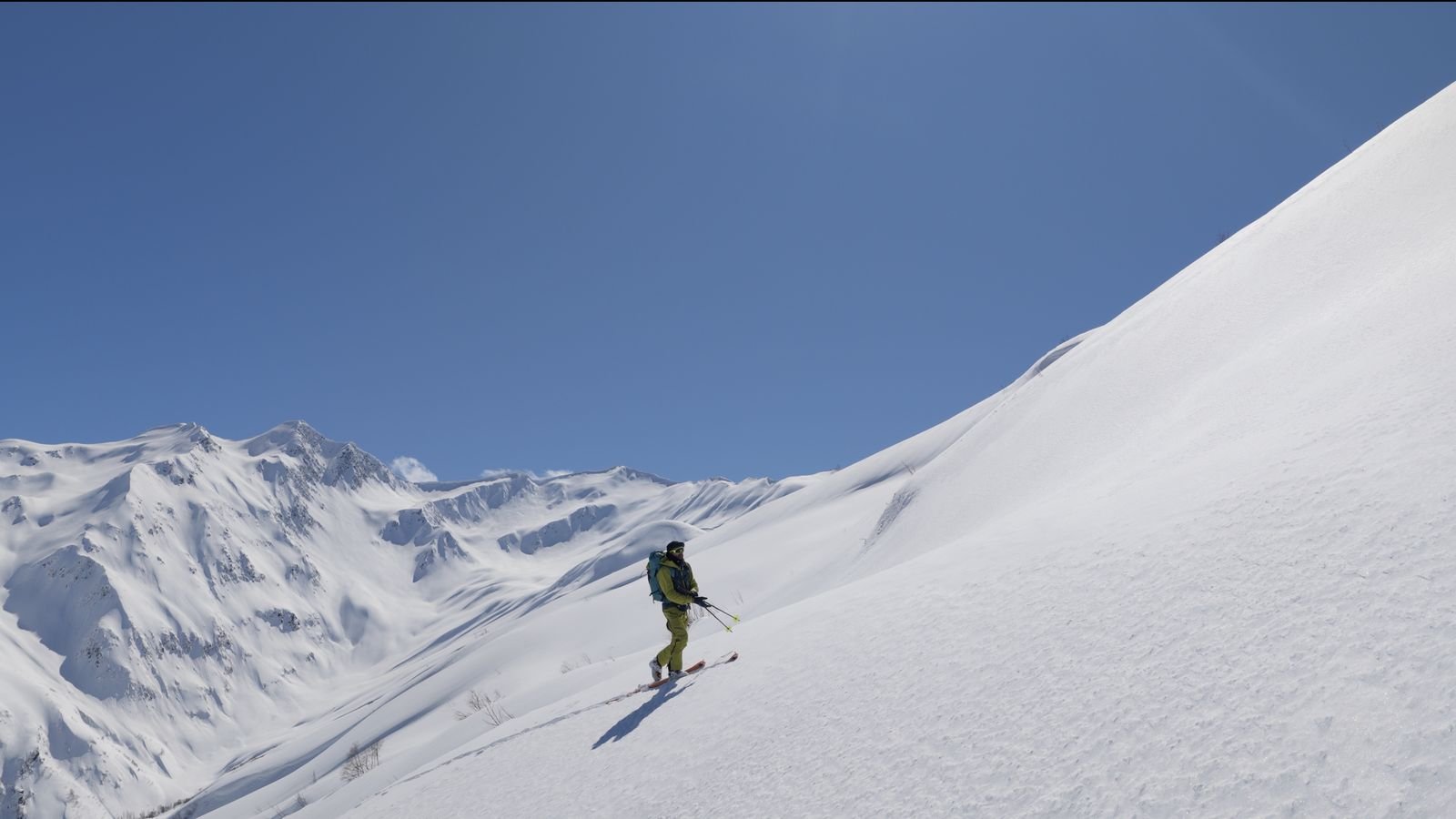
What the numbers do not capture is the setting. The lifts climb through dense stands of Caucasian fir, and the terrain beside the pistes is genuinely skiable rather than decorative. From the top the whole Mestia valley opens up, with Ushba's twin summits standing over the Becho side to the west and the Svaneti Range running east behind you. On a clear morning it is one of the easiest big views in the Caucasus to reach — you do not have to earn it with a five-hour skin.
Hatsvali at a glance
| Location | On Mount Zuruldi (2,348 m), directly above Mestia |
| Distance from Mestia | ~8 km by road; lower station ~500 m from the town centre |
| Lift-served elevation | 1,428 m – 2,347 m |
| Longest run | ~2,500 m, about 475 m vertical |
| Total pistes | ~5,495 m |
| Lifts | 4 (a chairlift, a gondola, two T-bars) |
| Lift operation | Check current lift status and opening times with MTA before travelling; wind, visibility and seasonal operations can change the timetable. |
| Season | Mid to late December until the end of March |
| Best for | Beginners, families, tree skiing, storm days, non-skiers riding up for the view |
The four lifts, one by one
Lower chair — Mestia to Hatsvali
A six-seat Doppelmayr chairlift, about 1,250 m long, running from 1,428 m to 1,898 m in about five minutes. This is the lift most people mean when they say "the Mestia gondola" — the lower section is a chair, not a gondola, so dress for the wind; the gondola is the stage above it. It leaves from a base area a short walk up the road from the Museum of History and Ethnography.
In late season, when the bottom of the mountain starts to go patchy, it becomes the way down as well — riding the chair back to the base is normal here and nobody thinks anything of it.
The two T-bars
Two surface lifts sit in the middle of the resort, between the top of the lower chair and the bottom of the upper one. They serve the gentler, more open ground around 1,900 m. If you are learning, this is where you will spend most of your first days: short laps, quick repetition, no long cold rides between attempts. Our instructors work this sector constantly during ski lessons because the turnaround is so fast — a beginner can get five or six runs into an hour here, which is impossible on a mountain built around long chairlifts. T-bars are a small skill of their own; if you have never used one, say so at the bottom rather than after you have fallen off.
Upper gondola — Hatsvali to Zuruldi
A ten-person Doppelmayr gondola, about 1,420 m long, running from 1,868 m to 2,347 m in roughly five minutes. It replaced the old open four-seat chair in 2021, so the ride itself is now out of the wind — but the top is not. Mid-winter daytime highs around Mestia average roughly −2 °C in January and February, and the top station sits in whatever wind the ridge is producing. Take a proper mid-layer, a buff and warm gloves, even if the walk to the base felt mild. The reward is the whole top of the resort: the Zuruldi café, the view, and access to the ridge that makes the Hatsvali freeride terrain reachable.
Season, hours and lift passes
When the resort runs
Hatsvali normally opens between the middle and the end of December and runs until the end of March — a shorter window than Tetnuldi, which sits higher and can keep going into April.
The opening date depends entirely on the autumn. Snow usually first arrives in Svaneti at the end of November, but December is often a dry, cold month here, and a thin early base can take weeks to become skiable. If your trip is fixed for mid-December, build in a plan B — a cultural day in Mestia, or a suitable valley walk, and treat any early lift opening as a possibility rather than a guarantee. Snow cover varies from winter to winter and across the mountain. Neither the calendar nor a regional snowfall average establishes safe conditions on a particular slope; check current information before travelling.
If you are still choosing dates, our best time to visit Svaneti page goes through the calendar month by month. The short version for Hatsvali: mid-February to late March, with the deepest snow and the longest days.
Daily hours
Check current lift status and opening times with MTA before travelling; wind, visibility and seasonal operations can change the timetable.
One practical note: the upper gondola does not always run in strong wind. If the ridge is windy, the lower half of the resort and the T-bars stay open and the top does not. Worth asking at the base before buying a pass.
Lift tickets
Tickets are sold per ride, per day, and as a three-day card usable on any dates across the season. The multi-day card is valid at both Hatsvali and Tetnuldi, which is useful if you plan to move between the two.
Those figures date from 2024 and we cannot promise them — resort pricing here changes without much announcement, so treat them as an order of magnitude and check at the ticket window. We do not resell lift tickets, so there is nothing in it for us either way.
What the skiing is actually like
The pistes at Hatsvali are broad, rolling and mostly blue-to-red in character. Nothing on the marked map is intimidating for a competent intermediate. Grooming is decent when the machines have been out; after a heavy storm it can take a day to catch up, and that is usually good news rather than bad.
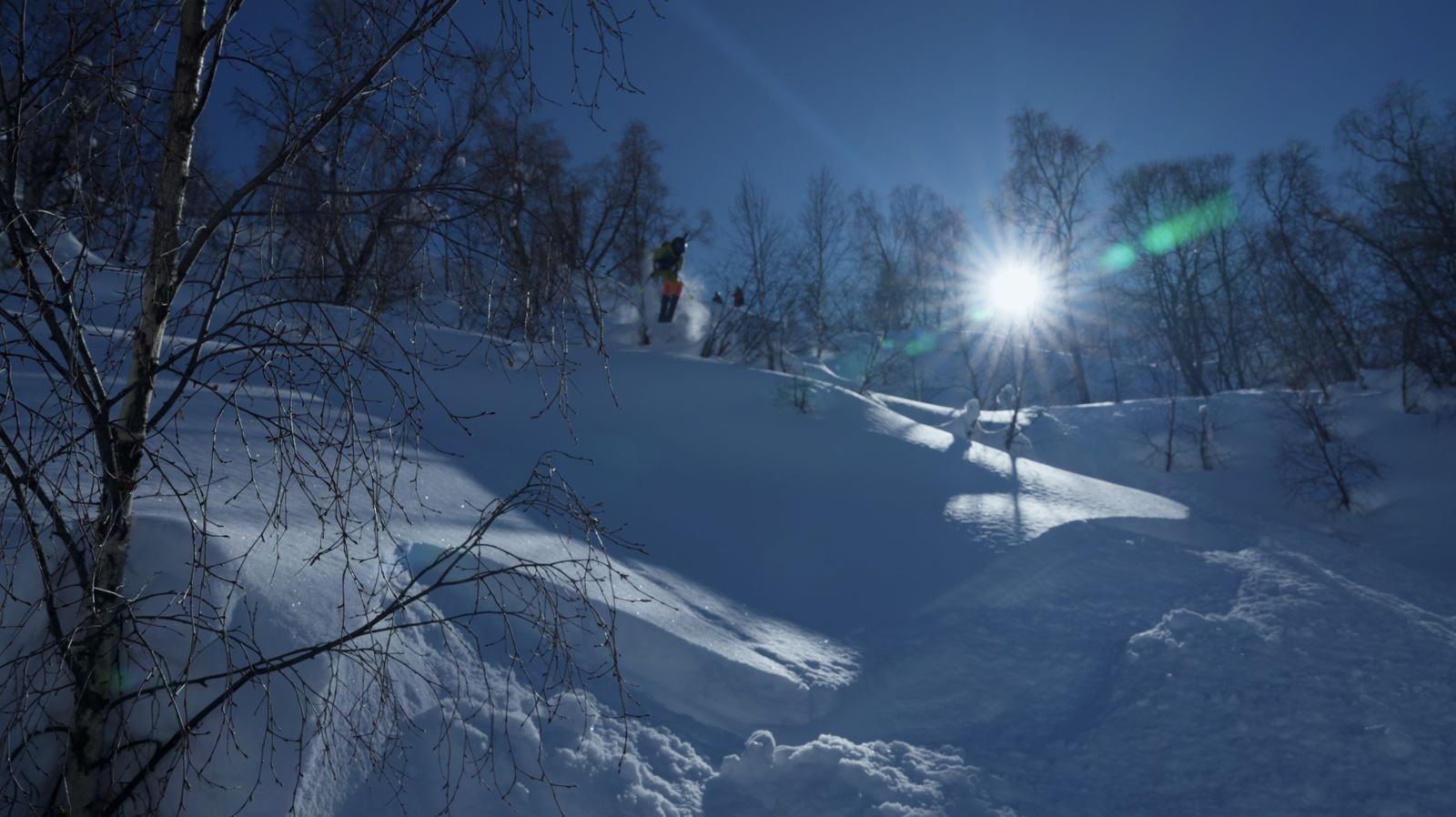
Where the hill gets interesting is immediately off the edges. The forest is dense fir with enough spacing on the main aspects to ski properly, and because the resort is small, that terrain gets tracked out far more slowly than you would expect. Two days after a storm you can still find untouched snow within sight of a chairlift.
A word on expectations: this is not a resort built for lap-after-lap high-speed cruising. Riding to the top and back takes time, chair then gondola, with a short walk between the stations. Most guests who ski Hatsvali well treat it as three or four deliberate descents rather than fifteen quick ones.
Hatsvali forest freeride
This is why the hill matters to us professionally, and why we send experienced skiers here on days when they thought they were going somewhere bigger.
The lines beside the lift
The simplest option: the ground either side of the ropeway corridor. You can see it from the chair, so you can read it before you commit, and it returns you to the lift line without navigation. It is the right first descent for anyone new to the mountain, and the right descent for a group whose abilities we have not yet assessed.
The forest cut-through
A route drops off the main piste into the trees and rejoins lower down, shortening the way back to the base. It is a playful pitch — rolls, natural banks, tight sections that reward a bit of pop — and it is what most of our guides ski for pleasure on a day off. It is also the run that catches people out in poor snow years, because the forest floor here is not smooth: early season, with a shallow base, there are stumps and deadfall under the surface. We do not take guests into it before the base is properly built.
The couloirs west along the ridge
From the top station, follow the ridge westward. Ten to twenty minutes of walking — or skinning, if the snow is deep enough that boot-packing becomes miserable — brings you above a handful of narrow, tree-flanked couloirs. These are the steepest lines the Hatsvali sector holds. They are short, and they are genuine: real terrain traps, real consequence, aspects that load differently from the piste side of the ridge.
We do not publish exact entries and recommend a qualified guide for off-piste terrain. Check current avalanche information for the area and assess the snow, terrain and group; a published warning or its absence cannot settle the route choice by itself. Conditions may require changing or cancelling a freeride day with us. Take a transceiver, shovel and probe; our rental shop has them if you do not own them.
Why tree skiing matters in Svaneti
Here is what visitors from the Alps often do not anticipate. The big snowfalls here come from Black Sea low-pressure systems that settle over the Caucasus for two or three days at a stretch, mostly in February and March. They deliver exactly the snow you came for — and cloud that sits on the mountain the entire time.
Above the treeline in that situation, the world turns into a single sheet of white with no horizon and no shadow. You cannot see the rolls under your skis, judge speed, or tell a convexity from a flat. It is not dangerous so much as useless — you end up skiing at walking pace, guessing.
Inside the forest, everything comes back. The trunks give your eye a fixed reference, the branches throw shadow onto the snow, and suddenly you can read the surface again. So the days when Tetnuldi's big open bowls are effectively unusable are the days Hatsvali is at its best: deep snow, no visibility problem, no crowds because everyone else has stayed in town assuming the skiing is off. It is also why we build storm-day flexibility into every freeride and ski touring programme we run — the plan changes with the sky, and Hatsvali is very often where it changes to.
Beginners, children and first turns
Hatsvali is the best place in Svaneti to learn, and it is not close.
The reasons are mundane and they matter. The learning terrain sits in the middle of the mountain around 1,900 m, served by short surface lifts, so a beginner's day is made of many quick repetitions instead of a few long ones. The base is fifteen minutes from town, so a lesson can finish at lunchtime and the rest of the day is free. There are cafés at the base and one at the top, so a cold child has somewhere to go. And the resort is small enough that a family with mixed abilities does not lose each other.
Our ski lessons run here for exactly these reasons — adults who have never worn skis, children, and intermediates who want to stop fighting their turns before heading into softer snow. Instruction is in English or Georgian, and equipment comes from our rental shop; we would rather set a beginner up on gear we know than watch them struggle on something poorly matched.
For families, the honest recommendation is a half day. Two to three hours on the hill, lunch in town or at the top, and an afternoon that is not spent watching a tired child get colder. Svaneti in winter has plenty to fill an afternoon: the museums, the towers, a sauna, a long slow supra dinner.
Zuruldi for people who are not skiing
You do not need skis to ride the lifts, and a lot of our guests do not.
The upper station at 2,347 m has a café, and it is worth the trip on its own account. The view runs west to Ushba — the double-headed peak that dominates the Becho side and is, for our money, the most striking mountain in Georgia — and east along the Svaneti Range. Below, Mestia sits in its valley with the towers visible as small vertical marks. It is the clearest, easiest overview of Upper Svaneti available to anyone who can sit on a chairlift.
The Zuruldi café was built by Tezo Japaridze, who did more than anyone to get lift-served skiing started in Svaneti in the first place. He died in 2014. The building he put at the top of this mountain is still where people sit, and locals still talk about him; ask an older Svan how the resort came to exist and his name is the answer you will get. It is worth knowing whose idea you are sitting inside.
Check current lift status and opening times with MTA before travelling; wind, visibility and seasonal operations can change the timetable.
Getting to Hatsvali from Mestia
Three ways, in order of how often our guests use them.
Walk. The lower station is roughly 500 m from the town centre — a ten to fifteen minute walk from most central guesthouses, uphill, past the ethnographic museum. In ski boots carrying skis it is honest work, but it remains the simplest option.
Taxi or hotel shuttle. Every guesthouse in Mestia can arrange a car and the ride is short. Worth it with children, with a lot of equipment, or if the morning is unpleasant. If you are with us, transport to the hill is part of how we organise the day — see transfers for the wider picture, including airport runs.
Drive. There is parking at the base. In deep snow the access road can be slow, and Mestia is not a place to be driving a two-wheel-drive hire car in January.
Getting to Mestia in the first place is the bigger question. Kutaisi is the nearest international airport at about 240 km — four to six hours on the road — and Zugdidi is 140 km, or three to four hours. Our how to get to Mestia page covers flights, the daytime train and what actually goes wrong in winter.
Hatsvali or Tetnuldi? How we choose
Both resorts are on the same multi-day lift card, so this is a question of which day to spend where rather than which to buy.
Choose Hatsvali when: it is snowing or the cloud is down; you are a beginner or teaching one; you have half a day rather than a full one; you want tree skiing; the wind is up, since the lower half keeps running when higher lifts stop; you have small children; or you do not want to spend an hour in a vehicle before you start skiing.
Choose Tetnuldi when: the sky is clear. Tetnuldi is 15 km from Mestia on the slopes of the 4,858 m peak of the same name, running from 2,265 m to 3,160 m, with around 13 km of piste and 895 m of lift-served vertical. It opened in February 2016, and access needs a proper vehicle. On a blue day it is not a fair contest.
A sensible pattern for a week: Tetnuldi on the clear days, Hatsvali on the grey ones, and one or two days on something else entirely — catskiing, ski touring, or heliskiing if budget and weather both allow.
Staying, renting and servicing gear
Where to stay. There is a hotel at Hatsvali itself, alongside the cafés, if being on the hill matters more than being in town. Most of our guests stay in Mestia, which has by far the widest choice of guesthouses and hotels in Svaneti and puts you within walking distance of the lower lift anyway. We also work with a mountain hotel for guests who want something more comfortable as a base for a week.
Rental. Alpine skis, snowboards, splitboards, touring setups and avalanche safety kit all come through our rental shop. If you are coming for freeride or touring, send us your weight, height and boot size in advance — the deeper the snow, the more the ski matters, and matching people to gear on the morning of a powder day is not how anyone should start.
Service. Svaneti snow in early season and in spring is hard on bases and edges. If you have flown in with your own skis, a tune before the first day is money well spent; our ski service workshop in Mestia handles grinding, waxing, edges and binding checks.
Safety and guiding
Inside the resort boundary the Svaneti rescue service operates and there is no charge for a call-out on the piste. The emergency number in Georgia is 112, and Mestia has a hospital on Ilia Gabliani Street with a 24-hour emergency entrance at the rear.
Outside the boundary the picture changes. Evacuation from terrain away from the lifts generally means a helicopter, which is a paid service and which you should assume your travel insurance needs to cover explicitly for off-piste skiing. Weather and darkness can prevent a lift-out entirely — a rescue call is not the same as a rescue.
Before going off piste, check whether current avalanche information covers your date and area. The guide must still assess the route, snowpack and group, and may change or cancel the plan. Carry appropriate equipment and know how to use it. Confirm how to call for help and what rescue cover your insurance provides; mobile reception is not guaranteed and a phone is not a rescue plan.
Ski Hatsvali with us
We are based in Mestia and we ski this hill more than anyone. Whether you want a first lesson, a storm-day tree run, a half day with the family, or a full guided freeride programme built around the forecast, tell us your dates and your level and we will put together something honest. Get in touch and book.
Nearby
Related
Skiing in Georgia
Place guide
Freeride Hatsvali
Guided programme
Ski lessons
Guided programme
Freeride
Guided programme
Tetnuldi
Place guide
Mestia
Place guide
Plan this with us
Local Svan guides, based in Mestia all year round.
FAQ
Good to know
01Is Hatsvali good for beginners?+
Yes — it is the best beginner terrain in Svaneti. The learning slopes sit in the middle of the mountain and are served by two T-bars, so you get short, frequent runs instead of long cold chairlift rides. The base is a short walk from Mestia, which makes half-day lessons easy to organise.
02How far is Hatsvali from Mestia?+
About 8 km by road, but the bottom station of the lower chairlift is only around 500 m from the centre of town — a ten to fifteen minute walk. It is the only skiing in Svaneti you can reach on foot from your guesthouse.
03How long does it take to get to the top?+
The lower chair takes about 5 minutes to 1,898 m; the gondola above it takes roughly another five to 2,347 m. Allow around 15 minutes base to Zuruldi including the walk between the stations, and dress for the top — it is colder than it looks.
04What are the lift hours and when does the season run?+
Check current lift status and opening times with MTA before travelling; wind, visibility and seasonal operations can change the timetable.
05How much is a lift ticket at Hatsvali?+
Tickets come per ride, per day or as a three-day card, and the multi-day card is valid at Tetnuldi too. Check the current rate at the window. Those are 2024 figures and should be confirmed at the ticket office.
06Can I go up Zuruldi without skiing?+
Yes. Foot passengers ride the lifts, and the café at 2,347 m is a destination in its own right for the view over Mestia, Ushba and the Svaneti Range. You can also walk up from Mestia if you are fit and equipped for winter conditions.
07Is the off-piste skiing at Hatsvali any good?+
Hatsvali has forest and ridge terrain used for freeride, but suitability depends on the day’s snow, weather and group. Forest cover does not remove avalanche risk. We recommend a qualified guide, appropriate avalanche equipment and training, plus a check of current information for the area. See our Hatsvali freeride day for the proposed programme; access and routes remain conditional.
08Should I ski Hatsvali or Tetnuldi?+
Weather decides. Clear skies mean Tetnuldi — bigger, higher, about 13 km of piste and 895 m of lift-served vertical. Storms, low cloud and flat light mean Hatsvali, where the trees give you visibility the open bowls cannot. On a week-long trip you will want both, and the multi-day card covers either. Our winter programmes move between them as conditions change.