
Svaneti · Georgia
Tetnuldi: the mountain, the ski resort and how to ski it
Type "Tetnuldi" into a search box and two different things come back tangled together. One is a mountain — a broad, glaciated peak of roughly 4,850 to 4,870 metres on the southern side of…
On this page
Overview
Type "Tetnuldi" into a search box and two different things come back tangled together. One is a mountain — a broad, glaciated peak of roughly 4,850 to 4,870 metres on the southern side of the Main Caucasus Range, in Upper Svaneti, northwest Georgia. The other is a ski resort that borrowed the mountain's name and sits on its northern, western and southwestern flanks, fifteen kilometres by road from Mestia. Not the same place, but close enough that you look up at one from the chairlift of the other.
The short version for a winter trip: the ski area runs from 2,265 to 3,160 metres, holds about 13 kilometres of marked piste, and gives 895 metres of lift-served vertical. It opened in February 2016, lift passes cost a fraction of European prices, and there is no hotel on the mountain — everybody sleeps in the valley and drives up.
We are a Svan company based in Mestia. Our guides grew up in these villages, several hold IFMGA/GMGA certification, and we work this hill all season. Below is what we would tell you before a trip.
Tetnuldi the mountain
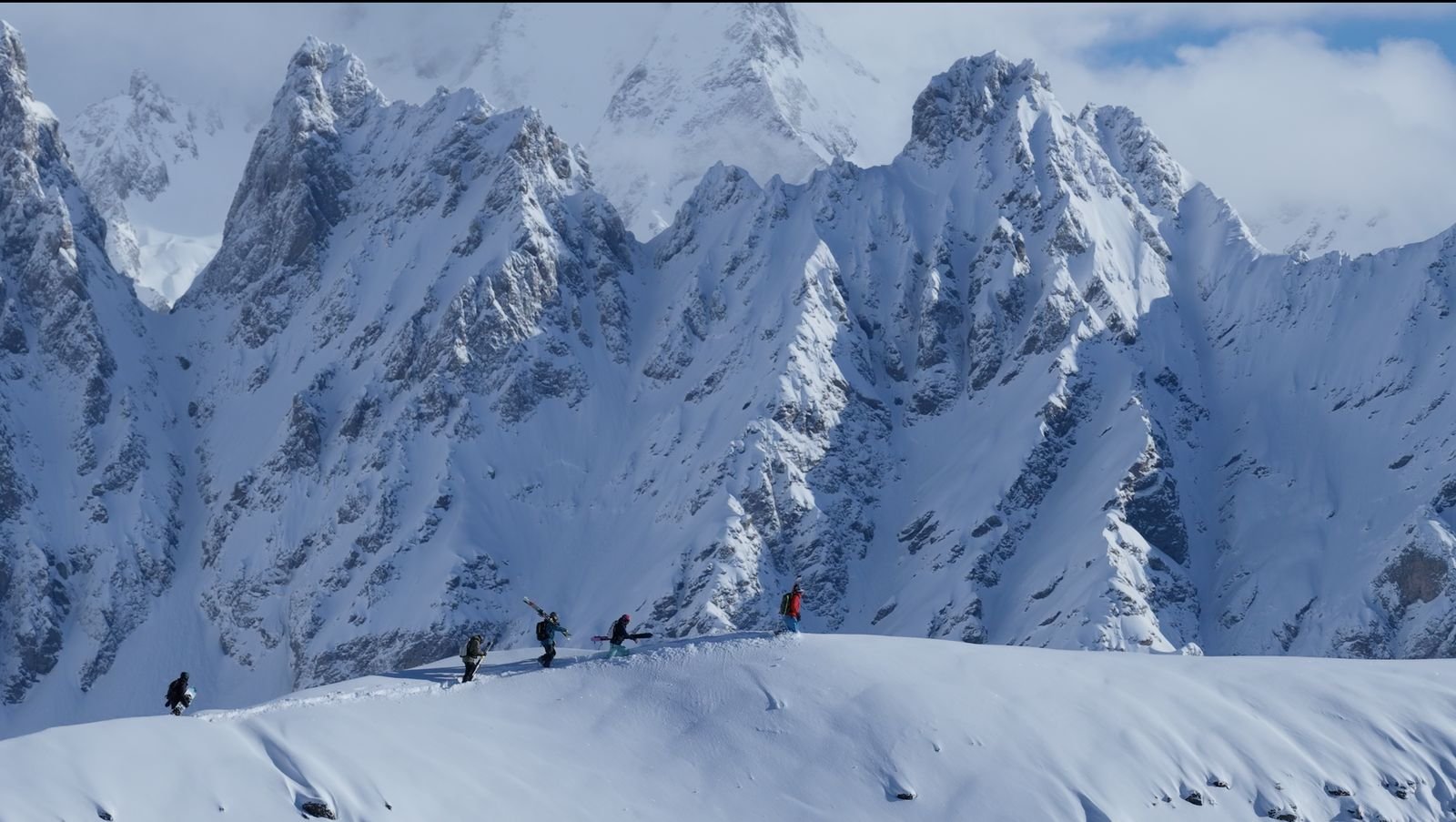
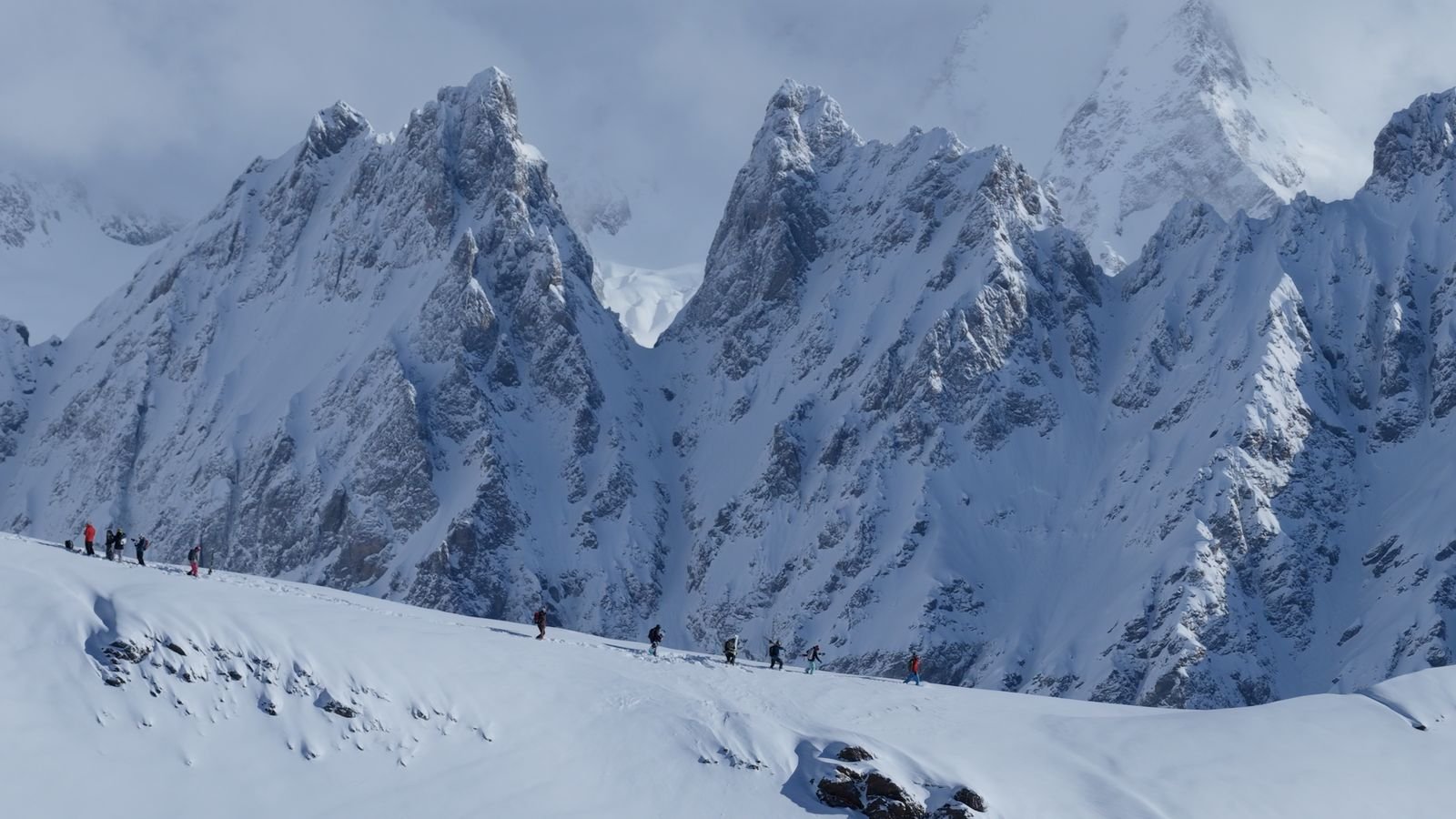
Tetnuldi belongs to the front rank of Georgian peaks, named in the same breath as Shkhara — 5,193 m, the country's highest summit, over in the Ushguli community — and twin-summited Ushba, whose south and north tops reach 4,710 m and 4,690 m above the Becho valley. Ushba is the skyline you will photograph from the Tetnuldi chairs; Tetnuldi is the one you can actually ski, which is why it has lifts and the other two do not.
How high is it?
Sources disagree, and we would rather say so than pick a number and pretend. The figure we use is 4,858 m. The national tourism portal prints 4,852 m, and older survey material also gives 4,869 m, sometimes within the same publication. For anything a guest actually does, a few metres of argument at the summit changes nothing; if you need a precise elevation, check a current national survey source.
The shape matters more than the number. Tetnuldi is a big snow-and-ice mountain with long sustained flanks rather than a slender spire, carrying glaciers on several sides, and that bulk is why the skiing works: broad, high, north-tilted ground that catches snow and keeps it cold.
The resort is not on the summit
Plainly, because this trips people up: the top lift station sits at 3,160 m, and the mountain continues for another kilometre and a half above that into glaciated terrain. Nobody skis the summit from a chairlift. What the lifts give you is cheap access to the mountain's lower half, and a starting point for days that go further.
Tetnuldi ski resort at a glance
| Location | N, W and SW slopes of Mount Tetnuldi |
| Vertical range | 2,265 m – 3,160 m |
| Marked pistes | About 13 km |
| Lift-served vertical | 895 m |
| Opened | February 2016 |
| Lift operation | Check current lift status and opening times with MTA before travelling; wind, visibility and seasonal operations can change the timetable. |
| Season | Roughly December to April |
| On the mountain | Restaurant and cafés, one rental outlet, no accommodation |
| Access | 15 km of mountain road from Mestia, 4WD required |
The lifts and how the mountain is laid out
The network is POMA-built and compact, but it covers the useful ground. Two six-seat detachable chairs, measuring 2,293 m and 1,483 m and rated at 3,000 and 2,200 people per hour, do the heavy lifting from the road-head through the main body of the ski area. Above them a four-seat chair of 500 m carries the line to the top of the area at 3,160 m. A separate four-seat chair of about 1,000 m works the side facing the village of Zhabeshi, and it unlocks the most interesting lift-served fall line here; a short J-bar covers the beginner ground at the base.
The other number worth remembering is about 2,690 m, the mid-mountain junction where the two six-seaters meet. Above it you are on open alpine slopes; below it the ground steepens through gullies and picks up trees on the way to the valley. That layout gives three different days from one ticket: lap the six-seaters for volume, add the top chair and take the whole vertical in one run, or work the Zhabeshi side and finish in a village instead of a car park. The top chair is the first to close when weather or avalanche danger turns, and the mid-mountain keeps working when it does.
Check current lift status and opening times with MTA before travelling; wind, visibility and seasonal operations can change the timetable.
Pistes and named runs
Thirteen kilometres of piste is not a large number on paper, and we will not pretend otherwise. What Tetnuldi gives you is 895 metres of lift-served vertical on an empty mountain, stacked downwards rather than spread sideways, with terrain either side of the lift corridors that stays skiable long after a storm.
Instead of colours and numbers, the runs carry Svan family names: Boris Kakhiani 1, 2 and 3, Goji Zurebiani, Ioseb Kakhiani and Iomber Kakhiani all appear on the map. Signage is thinner than you may be used to, so spend your first ride up the main chair reading the flank from the seat.
The pistes through the middle of the mountain are wide and generously graded — rolling terrain where an intermediate can carry speed without technical worry. The upper section is more exposed and weather-dependent; the lower third tests your legs at the end of a long lap. Facilities amount to a restaurant, a couple of cafés and one rental outlet, so carry what you need for the day.
Lift tickets and prices
Tickets are published per single ride, per day, and as a three-day card usable on any dates within the season.
The multi-day card is valid at both Svan resorts, so three days can be split between Tetnuldi and Hatsvali as the weather dictates. That matters: when a low sits on the region for days, Tetnuldi's open upper flanks lose all definition in flat light while Hatsvali's tree-lined runs stay skiable. Swapping resorts on the morning of, without buying a second ticket, is one of the genuinely good things about the Svan pass.
A caution on those numbers. They are from the 2024 season, and Georgian tariffs are reset annually, so read them as an order of magnitude rather than a quote. We confirm current prices with every booking. Our own guiding, transport and package prices live on the booking page.
Off-piste and freeride at Tetnuldi
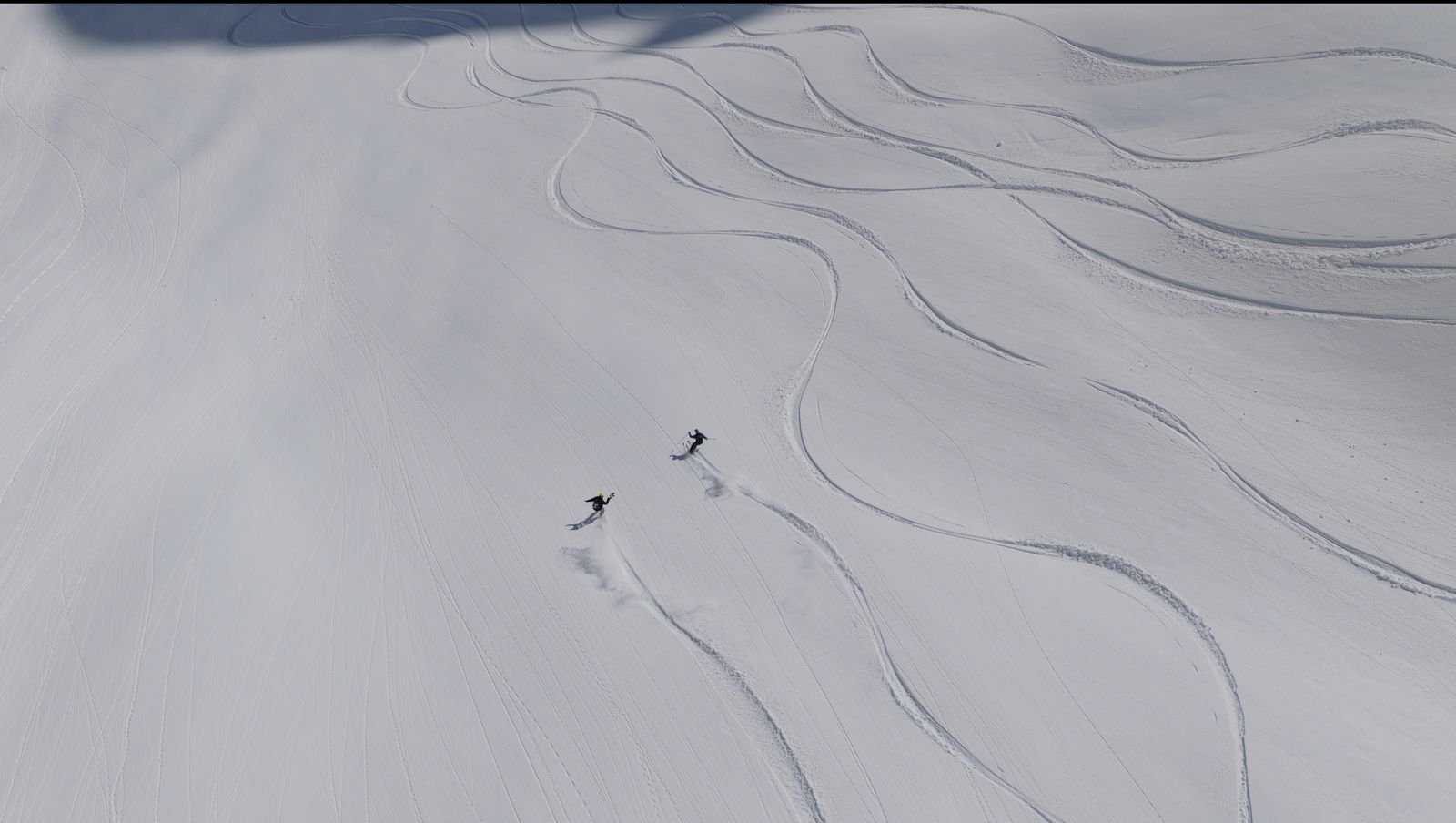
This is why most of our guests come. The terrain either side of the lift corridors is the entry point — visible from the chair, quick to reach, and enough on its own after a storm. It also tracks out first, so on a week-long trip treat it as the warm-up rather than the objective.
The couloir from the top. From the highest point of the ski area a wide couloir drops away from the piste network. It is the signature descent of the resort: a big open feature with room for real turns rather than a tight technical slot. The catch is the exit, because the run-out does not return you to the lifts by itself — there is a traverse back, and it is not optional. Stay in the fall line too long and you finish in the wrong drainage, well below the base station, with a walk ahead of you. It needs decent visibility, a group skiing at similar speed and somebody who knows where the traverse begins. This is the terrain our Tetnuldi freeride days are built around.
Descents to Zhabeshi. The other big lift-served option is to ski the Zhabeshi flank and keep going, down into the village — a point-to-point run that ends among tower houses rather than parked cars. If you are sleeping in Zhabeshi or Chvabiani it doubles as your ride home.
The traverse towards Adishi. Longer and wilder, and our recommendation for anyone with a full day and the fitness to use it. The line leaves the top station heading south, crosses a wide shallow bowl, then works anticlockwise around the mountain's spurs — climbing a little, traversing a lot — until the shoulder finally releases you down towards Adishi. The route card gives 5.1 km, a high point of 3,046 m, about 990 metres of descent against only 50 of climbing, and a steepest angle near 28°. Technically easy; in consequence, not — you are committed and far from help once round the corner. Two conditions govern it: good visibility, because the traverse is read from the terrain, and the state of the Adishi road, because that is how you get out. The last six kilometres to the village can be impassable for days after heavy snow, so we check with drivers there that morning.
Ski touring around Tetnuldi
The lifts are a tool, not a limit — some of our best days start where the piste map ends.
Skinning up from Chvabiani. A forest route climbs from Chvabiani, in the Mulakhi valley, to the resort: 5.6 km, about 1,643 m to 2,689 m, roughly 1,056 metres of ascent, nothing steeper than 25°. Graded easy, almost all of it under trees, and a sensible first day on skins.
The shape of that day is the point. Skin up after breakfast — around two hours for a fit party on a set track, three and a half allowed on the route card. That puts you at the lift stations before the Mestia crowd has finished driving. You ride the mountain through the middle of the day, and at closing time you drop back into the forest and follow your own morning track down to the guesthouse door. When the light dies early or the top chair never opens, that last descent is often the best skiing you do.
The track leaves the upper end of the village, crosses the bridge and picks up the summer path to a wooded ridge. Either side of the ridge works: one way adds distance but breaks out into clearings, the other is quicker and stays under cover. Our guides choose by visibility.
Onward from the resort. The Adishi traverse is as much a touring day as a freeride one. Beyond it, from Adishi itself, sits the most serious line on this side of the mountain — the couloir known as the Nest of Amaranths. The numbers are honest about what it asks: 11 km, 2,100 m to 3,400 m, 1,400 metres up and the same back down, a steepest section around 45°, an eight-hour day with five and a half hours of skinning, and a remoteness rating at the top of the scale. The approach crosses a boulder field called the Theatre of Stones — skiable once it is buried, expensive for your bases when it is not — and the couloir tops out at a pass with the glaciers laid out in front of you. The final pitch is usually bootpacked, so bring crampons. This is a guided objective, and we run it through our Adishi ski touring trips.
Catski and heliskiing
Catski offers vehicle-assisted access outside the lift network, subject to the agreed programme and current conditions. A lift closure due to wind or snow does not establish that catskiing can operate. Access and alternatives need a separate assessment. Details are on our Tetnuldi catski page.
Heliskiing opens ground nothing else reaches: big vertical, remote aspects, and the freedom to chase whichever slope holds the best snow that morning. It is the most expensive way to ski in Georgia, and the most weather-dependent.
One point applies to all of it. Rescue inside the resort boundary carries no charge. Beyond it, the rescue service calls on whichever heliski company is operating that season, and the flight is billed to the person being carried — so insurance covering off-piste skiing and helicopter evacuation is not optional. We ask every guest for it.
Getting to Tetnuldi
The resort is 15 km from Mestia by a road that climbs to a pass and behaves like a mountain road in winter. 4WD is required — not recommended, required. Ordinary hire cars do not make it, and a few people learn that expensively every season.
From Mestia you have three options: a guesthouse shuttle, which almost every property in town runs daily in season; a taxi from around Seti Square, price and return time agreed before you get in; or a booked transfer with us, using local drivers who know the pass. If you ski with our guides, transport is normally built into the day. From Chvabiani there is a fourth way up: on skins, 5.6 km and 1,056 m, roughly two hours — see below.
Reaching Mestia is the longer journey. Kutaisi, the closest international airport, is 240 km and four to six hours away; Tbilisi 480 km (7–9 hours), Batumi 270 km (7–8), Zugdidi 140 km (3–4). Small domestic flights land in Mestia too — cheap and spectacular, but readily cancelled in bad weather, so never build a tight connection round one.
Season and snow: what the months do
Snow at Tetnuldi varies with storms, wind, temperature and aspect. General regional figures do not establish the depth or stability on a particular slope, so check current conditions and the resort’s operating status before travelling. The usual planning window is roughly December to April; our short answer to "when should I come" is mid-February to late March, and the longer one is in our guide to the best time to visit Svaneti.
Mid-December to mid-January. First snow usually falls at the end of November. Where it arrives deep — over a metre and a half — and December stays mild, the base sets up well. Where the early cover is thin and hard frosts follow, that shallow layer breaks down into depth hoar, and once buried it can sit at the bottom of the snowpack for months. It is the reason avalanche assessment in Svaneti so often comes back to what the weather did in December. These weeks are frequently dry as well, so early-season off-piste means skiing over things you cannot see.
Late January through March. The best window. Snow builds on every aspect, higher ground fills in, and the range of routes we can offer roughly doubles. February and March are dominated by low-pressure systems that park over the region for two or three days at a time. They are what fills the mountain in, and they are also why you will spend part of your week in trees: cloud settles on the upper flanks and the light goes completely flat, which is precisely when the Hatsvali half of the pass pays for itself. In the last third of March, daytime temperatures start crossing zero and dropping back overnight, and buried weak layers begin reacting to the warmth.
April. Spring reaches the valleys early in the month, but Tetnuldi keeps working, and it is one of the better months for steep skiing here: consolidated pack, predictable corn, no crowds. Early start, early finish.
Be clear about one thing: Check current avalanche information for the area and date. Check the publication time, geographical coverage and limits of any bulletin or warning. Information for one area or day must not be assumed to cover another. Combine relevant published information with a current route and snowpack assessment; the absence of a warning is not evidence of safe conditions.
Where to stay: Mestia or the villages
Mestia is the obvious base and the right one for most guests: the widest choice of hotels and guesthouses in Svaneti, the restaurants, the museums, and Hatsvali's lower lift almost in town, so a bad-weather day still has skiing in it. The cost is the daily drive — fifteen kilometres each way, roughly forty minutes.
Chvabiani and Zhabeshi, about 11 km up the Mulakhura valley from Mestia in the Mulakhi community, are our quiet recommendation for anyone skiing Tetnuldi most days. The argument is transport. You can ski off the mountain straight into Zhabeshi in the afternoon, which deletes the evening drive; the Chvabiani skin track can delete the morning one; and what driving remains is shorter and cheaper, because the villages already sit on the resort side of the turning. What you give up is choice — a handful of family guesthouses instead of a town, dinner being whatever the household is cooking. Not much of a sacrifice.
Adishi, at 2,040 m with a permanent population of about twenty, is not a base for lift skiing. It is where you sleep either side of the traverse or the Nest of Amaranths, and it is among the most remarkable places in Svaneti: a tenth-century church, almost no cars, a road that closes when it feels like it. Guesthouses are simple: bring a sleeping bag and indoor shoes. Wherever you stay, book early — village beds are limited in February.
Who Tetnuldi suits
Beginners. Yes, with a caveat. The middle of the mountain is wide, open and forgiving, with far more easy mileage than the piste count suggests. But with sparse signage, a high top station and real weather, a first-ever day on skis is better spent lower down at Hatsvali. Two mornings with an instructor will change what the rest of the week looks like.
Intermediates. The sweet spot. Top-to-bottom laps of 895 metres on empty pistes, for the price of a European coffee, are close to the whole point of skiing in Georgia.
Advanced and expert. The top-station couloir, Zhabeshi flanks, Adishi traverse and touring objectives require route-specific assessment. Lift access does not make off-piste terrain managed or suitable. Check current avalanche information and resort closures, use qualified local guidance and appropriate equipment and training, and be prepared to change or cancel the plan.
What we run at Tetnuldi
- Tetnuldi freeride — lift-served off-piste with a Svan guide, built around the top-station couloir and the Zhabeshi flanks.
- Catski at Tetnuldi — snowcat access beyond the lifts, small groups, no skinning.
- Ski touring — from the forest climb out of Chvabiani to multi-day traverses across the region.
- Adishi ski touring — the traverse from the resort and the couloir above the village.
- Heliskiing in Georgia — the big-vertical option when conditions and budget align.
- Ski lessons — instruction at Tetnuldi and Hatsvali, from first turns to off-piste technique.
- Rental and servicing — touring and avalanche equipment, tuning and repairs; ask before you pay to fly your own skis across Europe.
We also run the non-skiing half of a winter week: village walks, Svan supra dinners in a family house, the Mestia museums.
Plan your Tetnuldi ski trip
Want several mountain days from one base in Mestia? Compare our Svaneti winter packages: the 7-, 10- and 14-day programmes combine resort skiing, freeride, touring and other winter activities. Check the detailed Classic and Signature itineraries rather than treating every programme day as a ski day.
Tell us when you can travel, how you ski and how much walking you want to do, and we will build the week around it — lifts, freeride, catski, touring, transfers and a bed in the right village. We answer messages ourselves, from Mestia, usually the same day. Start on the booking page.
Where to stay
Related
Skiing in Georgia
Place guide
Freeride Tetnuldi
Guided programme
Catski Tetnuldi
Guided programme
Ski touring
Guided programme
Heliskiing
Guided programme
Hatsvali
Place guide
Plan this with us
Local Svan guides, based in Mestia all year round.
FAQ
Good to know
01How high is Mount Tetnuldi?+
The height we use is 4,858 m. You will also see 4,852 m and 4,869 m in print, and sources genuinely contradict one another, so we quote the best-supported figure and note that it varies. The ski resort tops out far below, at about 3,160 m.
02How far is Tetnuldi ski resort from Mestia, and how do I get there?+
Fifteen kilometres, on a road that requires a 4WD vehicle in winter — about forty minutes in normal conditions. Guesthouse shuttles, taxis from central Mestia and pre-booked transfers are the practical ways up, and all three run daily in season.
03When is the Tetnuldi ski season?+
Roughly December to April, with mid-February to late March the strongest period for both snow depth and daylight. April holds up well at altitude and suits steep skiing, given an early start and finish.
04How much does a Tetnuldi lift pass cost?+
Tickets come per ride, per day or as a three-day card, and the multi-day card is valid at Hatsvali too. Check the current rate at the window. Those figures are from the 2024 season and are reviewed annually, so check before you budget.
05Is Tetnuldi good for beginners?+
For a second or third week on skis, yes: the middle of the mountain is wide and gently graded, and the pistes are quiet. For an absolute first day, Hatsvali is friendlier, and lessons beat extra lift time.
06Is there a hotel at Tetnuldi?+
No. The mountain has a restaurant, cafés and one rental outlet, nothing else. Everyone stays in Mestia or in the Mulakhi villages and travels up each morning.
07Tetnuldi or Hatsvali — which should I choose?+
Tetnuldi for altitude, vertical and off-piste; Hatsvali for convenience, trees and bad-weather days. Hatsvali sits directly above Mestia with a top station at 2,347 m and a longest run of 2.5 km, so it is a much smaller hill — but when cloud swallows Tetnuldi's upper flanks, its forested runs are the ones still worth skiing. The three-day pass covers both, so most guests use them as a pair.
08Do I need a guide to ski off-piste at Tetnuldi?+
We strongly recommend a qualified guide for off-piste routes, together with appropriate avalanche equipment and training. Check current resort instructions and avalanche information for your area and date. Route-finding and snowpack assessment remain essential, including on traverses; a guide does not eliminate risk and may change or cancel the outing.