
Svaneti · Georgia
Koruldi Lakes: The Ushba Viewpoint Above Mestia
Ask us in the office what to do with one clear day in Mestia and the answer is almost always the same: go up to Koruldi.
On this page
Overview
Ask us in the office what to do with one clear day in Mestia and the answer is almost always the same: go up to Koruldi. Nothing else within reach of town gives you as much mountain for the effort. You climb out of the valley, the towers shrink below you, the ridge levels off — and Ushba is simply there, both summits, face on, close enough that people stop talking for a while.
We have taken guests up to the Koruldi Lakes on foot, on horseback, in a Land Cruiser, under a snowcat and on climbing skins. All four work; they are not interchangeable. The honest differences between them are what this page is about — what the walk really costs in hours and vertical metres, when the light is worth getting up for, and the winter profile for anyone thinking about February rather than July.
What the Koruldi Lakes Are
The Koruldi Lakes are a cluster of small alpine tarns on a broad shelf of the ridge that rises directly north of Mestia. That shelf sits at around 2,740 m — high enough to be genuinely alpine, low enough that the ground up there is grass, rock and old snow patches rather than glacier.
Do not arrive expecting a lake in the postcard sense. These are shallow snowmelt pools whose character changes across the season: full and reflective in late June and early July, when the whole shelf is boggy underfoot, and reduced by late August in a dry summer to damp hollows ringed with cracked mud. We say so in advance because we have watched guests be quietly disappointed. The water is the foreground, not the subject.
The subject is behind it.
Why everyone actually comes: Ushba
Ushba is why Koruldi is the single most-walked objective above Mestia. From the ridge you get a frontal, unobstructed view of both summits — the south peak at 4,710 m, the north at 4,690 m — with nothing between you and the mountain but air.
It is a strange peak: twin-headed, absurdly steep on every side, and it earned the nickname "the Matterhorn of the Caucasus" from people who had seen the original and still thought the comparison held. It is among the hardest and most dangerous summits in the range. In Svan tradition the name is read as the mountain of witches, or of storms, and it is one of our sacred mountains — not decoration for visitors, but how people here still talk about it. More on our Ushba page.
You can see Ushba from plenty of places in Svaneti — from Mestia on a good morning, from the Hatsvali and Zuruldi ridges, from Tetnuldi, from the length of the Becho valley. What Koruldi adds is scale without distance: you are high, you are close, and the mountain fills the frame instead of sitting politely at the back of it.
The Koruldi ridge itself
Do not treat the lakes as the end of the line. The shelf runs on north and west along the Koruldi ridge, and every few hundred metres you continue opens more — more of Ushba's south wall, more of the glacier basin beneath it, eventually a long look east along the main Caucasus range. Fit walkers with time in hand should keep going past the water for another twenty to forty minutes. Most people do not, and miss the best of it.
The Four Ways Up
| Option | Effort | Typical day | Who it suits |
|---|---|---|---|
| On foot | High | 7–9 hours round trip from Mestia | Fit walkers who want the whole ascent |
| On horseback | Low to moderate | 5–7 hours round trip | Anyone happy to sit a horse for hours |
| By 4×4 (summer) | Minimal | 2–4 hours with stops | Short on time, limited mobility, families |
| Snowcat or skins (winter) | Minimal / very high | Half day / full day | Skiers and splitboarders |
1. On foot
This is the classic and it is a proper day. From town at roughly 1,490 m to the shelf at about 2,740 m you climb something in the order of 1,250 vertical metres, on a steep, largely unshaded track that gains height from the first switchback.
Our working numbers, from guiding it repeatedly: 4 to 6 hours up for an averagely fit walker who stops to breathe and eat, 2.5 to 3.5 hours down, and a total day of 7 to 9 hours including a proper sit at the top. Strong hikers go faster; nobody should plan on it. Add time in heat, which is the most reliable thing that slows people here. The guided version is our Koruldi Lakes hike, at the demanding end of our hiking programme.
2. On horseback
Horses have used this ridge for as long as anyone has grazed livestock on it, and the track suits them. You ride the steep lower and middle sections — exactly where the hike takes its toll — and walk short stretches where the ground is loose.
The honest picture: this is not a soft option, it is a different effort. Four or five hours in the saddle on steep ground uses muscles most visitors have never used, and almost everyone is stiff next morning. What it does is convert a hard cardiovascular day into a manageable one — right for anyone who wants the Ushba view without the fitness prerequisite, and for mixed groups where not everyone walks at the same speed. No riding experience needed. See horseback riding to Koruldi and our other horse riding trips.
3. By 4×4 in summer
A rough vehicle track climbs toward the Koruldi area, and in summer a capable 4×4 with a local driver takes you most of the way. It is not a road in any comfortable sense — steep, rutted and exposed. It works roughly from mid-June to September, depending on snow and on what spring rain did to the surface; when we say the track is not open, it is not open.
This is the answer for travellers with one afternoon, for knees with opinions, for families with small children, and for photographers who need to be on the ridge at a specific hour. A good hybrid: drive up, walk the ridge for an hour or two, drive down. Arrange it through our transfers, quoted per vehicle rather than per person.
4. In winter — snowcat or skins
From roughly December to April the summer track vanishes under snow and Koruldi becomes another place entirely.
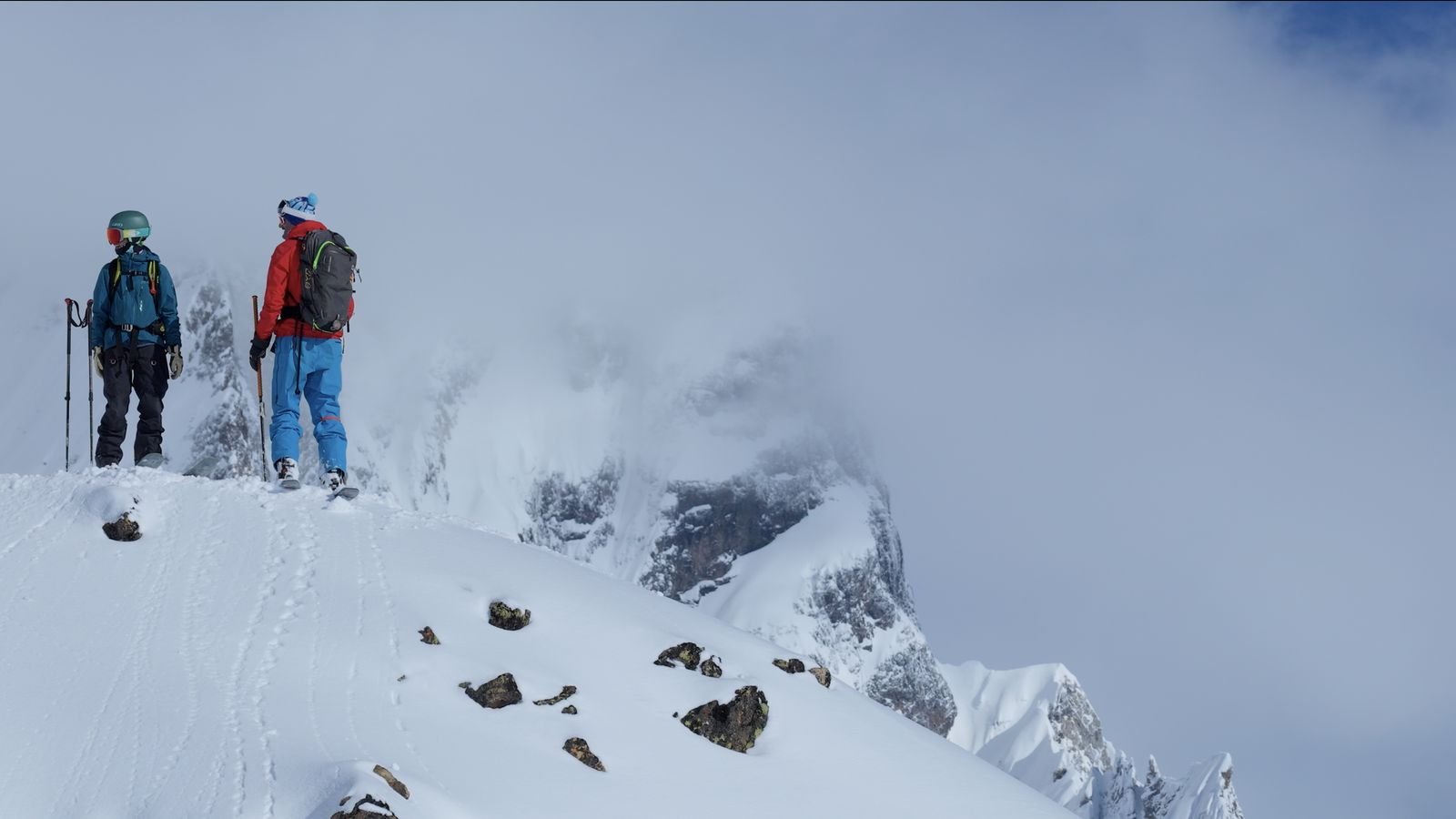
By snowcat. Our Koruldi catski machine runs skiers high on the ridge, turning a nine-hour touring day into a series of descents. The same open, moderate-angled terrain that makes the ridge a good skin track makes it excellent catski ground — wide, uncomplicated, holding cold snow on the eastern flank well into the morning. See catskiing for how the days are structured.
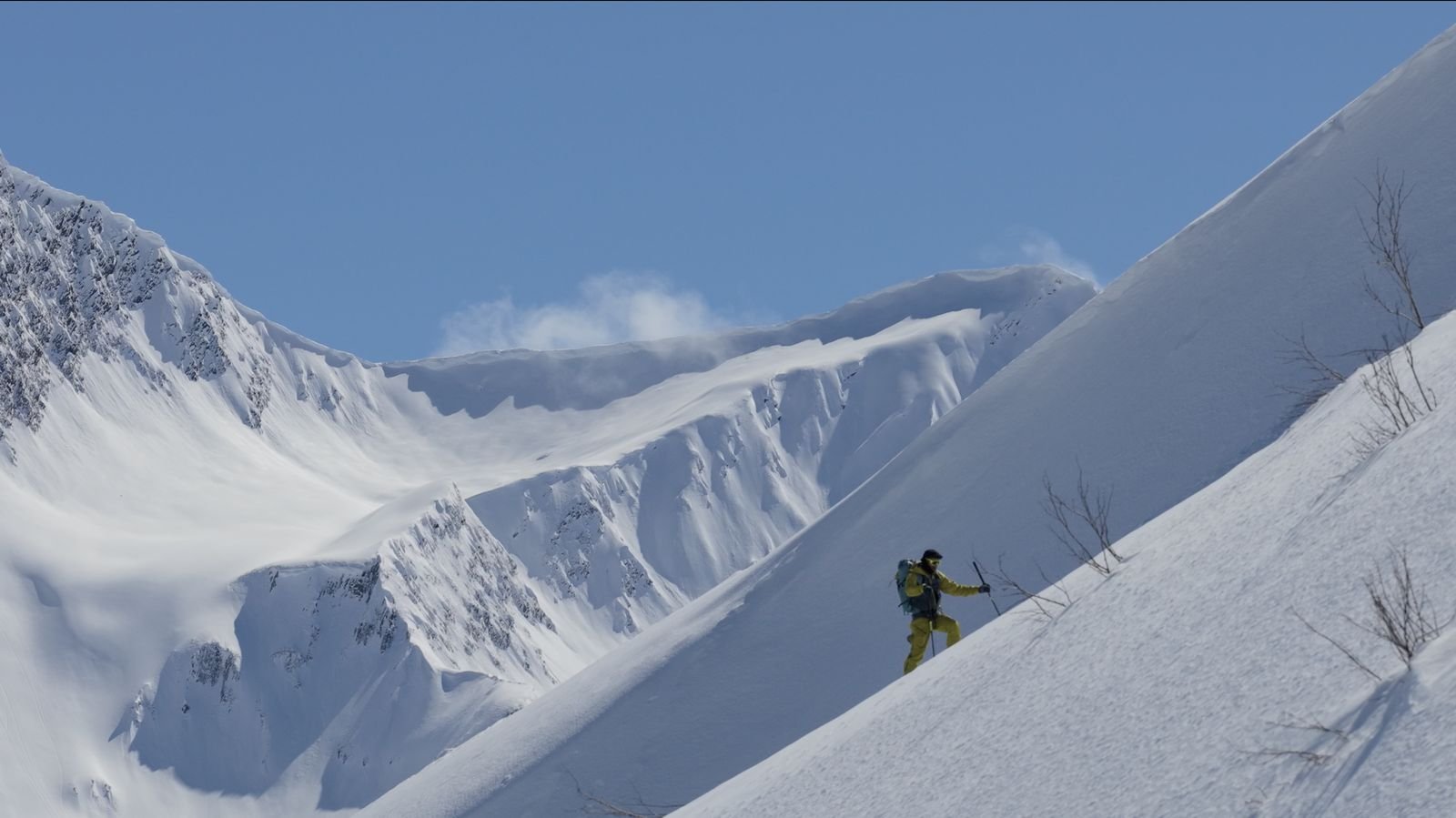
On skins. The full tour climbs the same ground the summer walkers use, and deserves its own section.
Hiking Koruldi: What the Walk Demands
The shape of the climb
The track leaves the north edge of Mestia and climbs immediately — almost no warm-up, and within an hour a view over the town's towers that most visitors never see.
The lower half is the sweaty half: mixed forest and open slope, dusty when dry, greasy when wet. Higher up the trees thin and you break onto open pasture, where the gradient eases and Ushba starts appearing in pieces before it shows itself whole. The last section crosses open alpine ground to the shelf, and this is where the wind lives. It can be twenty degrees and still in Mestia and cold enough for hat and gloves up top; people who left the extra layer at the guesthouse regret it every time.
The cross: your honest halfway marker
Partway up the ridge stands a large metal cross, visible from parts of Mestia and unmissable on the walk. Use it: it is a fair proxy for halfway in vertical terms and the best place on the route to make an honest decision.
Our rule of thumb: if the cross has taken you more than three hours, or you arrived there already tired, turn around. It is a fine destination in itself. What you should not do is push on with nothing left — the descent is long and hard on the knees, and being emptied out at 2,740 m with hours of downhill ahead is how a good day becomes a bad one.
Water, food, altitude
There is running water on parts of the lower route early in the season and much less by late August, so we do not treat it as reliable: carry at least two litres each, three in July and August heat. Do not drink from the tarns — they are shallow, still and grazed around. There is nothing to buy on the mountain: no hut, no kiosk, no café. Whatever you eat up there, you carried, and the commonest cause of a miserable descent is not eating enough on the climb.
At 2,740 m altitude is real but mild — expect to breathe harder, walk slower and feel the sun more. Headaches here are far more often dehydration than altitude. Drink steadily, keep the pace conversational low down, and if someone develops a genuine headache with nausea the remedy is simple: go down. You lose height fast on this trail, which is one of its few mercies.
Weather turns
Svaneti has a humid, Black Sea-influenced climate and these mountains manufacture their own afternoons — regional precipitation runs anywhere from 1,000 to 3,200 mm a year, much of it arriving as cloud that builds through the day. The practical consequence: the morning is not the same day as the afternoon. A clear 07:00 start often becomes a grey, blown-out 15:00, and July and August thunderstorms tend to arrive late. On an exposed ridge with no shelter that matters, so we plan to get high early and be off open ground before the weather organises itself. We cross-check yr.no, meteoblue and Windy — then look at the sky over the Chalaadi side, because build-up shows there first.
Koruldi in Winter: The Ski Touring Route
The ridge north of Mestia is one of the region's benchmark tours, and it uses the same line as the summer walk.
| Parameter | Value |
|---|---|
| Base | Mestia / resort side |
| Drive to trailhead | 20 minutes |
| Aspect | East |
| Duration | 9 hours (7 hours skinning) |
| Distance | 19 km |
| Lowest point | 1,484 m |
| Highest point | 3,355 m |
| Ascent / descent | 1,952 m / 1,952 m |
| Steepest angle | 26° |
| Best months | February–April |
| Terrain | Open |
| Grade | Moderate · S2 · E1 (low exposure) · Extremely Remote |
| Trailhead | 43.0674, 42.7484 |
An endurance problem, not a technical one
Read the two numbers that matter together: 1,952 m of ascent and 26° maximum. Almost two vertical kilometres of climbing, and nothing steeper than a firm blue run. Nothing here will frighten a competent skier; it will grind them down. Seven hours of continuous skinning is a long time to hold a rhythm, and the Moderate grade in this system carries a fitness assumption most people underestimate — it is written for skiers whose conditioning is genuinely strong, not merely adequate. We turn people around here more often for fitness than for snow.
The S2 descent grade means open slopes with room to turn where you like, and nothing that demands technique beyond confident intermediate skiing. E1 exposure means a fall costs you the slope itself rather than a cliff below it. Those two grades are why we can take strong intermediates on a day with these numbers — provided they know what they are signing up for physically.
The descent
Here is the payoff. You ski back down the way you climbed, on open moderate ground, and you simply keep going — close to 2,000 vertical metres in one continuous run toward town, with nothing to break it up. Nothing else you can start and finish in Mestia itself gives you an unbroken drop of that size. Timing matters on this aspect: east catches the sun early, which is both gift and trap, and leaving the top too late in April turns the lower half to heavy mush.
Hazards we plan for
The line is uncomplicated but the day is committing, and the route is rated Extremely Remote — the chance of anyone reaching you quickly is small.
- Wind slab high on the ridge. The rollovers up there collect loaded snow. This is the section that needs judgement rather than legs, and the one most likely to make us turn.
- Flat light on the plateau. The ground around the lake basin has nothing to steer by — no trees, no distinct terrain edge — and in cloud parties get lost within a few hundred metres of where they meant to be. A pre-loaded GPS track is not optional.
- Cornices build along the crest and are not always obvious from above.
- The length itself. A front arriving at hour seven, high on the ridge, is the scenario the whole day is planned around.
February to April is the window, with mid-February to late March the sweet spot for snow quality. April brings longer days and spring consolidation but demands earlier starts. More on the ski touring page and under winter in Svaneti.
A word on avalanche awareness: check current avalanche information for the area and date before setting out. Local observations and qualified guidance can inform the route choice, but neither a bulletin nor local knowledge replaces assessment of the day’s snowpack and terrain. Early-season cold on a thin base builds weak layers that persist for months, and late March — when daily temperatures swing through zero — is when they tend to wake up. Low-angle terrain is not proof of safety; assess the whole route and any slopes above it. It makes it a place to bring judgement to, which is what our guides are for. Several hold IFMGA or GMGA certification.
Best Time of Day and Year
Sunrise on the ridge is the photograph: Ushba's east aspects catch first light and run through pink to gold while the valley below is still blue. On foot that means starting in the dark; by 4×4, a very early pickup. Mid-morning, 08:00 to 11:00, is our standard target — the mountain is usually still clear, the light has angle, and you are ahead of the build-up. Midday gives the flattest light and the least reliable weather, which is when most people arrive and why so many Koruldi photographs look washed out.
By month:
- June — snow still on the shelf, tarns at their fullest, 4×4 track often not yet open. Green, wet, dramatic.
- July–August — peak walking and riding conditions, longest days, but also the busiest and most thunderstorm-prone. Start early.
- September — our quiet favourite: best air clarity, lower light all day, crowds gone, Ushba visible more often than through August haze. Cold mornings.
- October — beautiful and unreliable; first snow can close the track without warning.
- December–April — winter operations only, snowcat or skins.
See also when to visit Svaneti and our summer programme.
When Ushba hides
We would rather set expectations than sell disappointment: Ushba is a cloud magnet. It makes its own weather, and you can stand on the Koruldi ridge on a broadly fine day and see a grey wall where the mountain should be. The pattern is consistent — mornings beat afternoons, clear cold days after a front beat everything, and long warm spells build haze that softens the peak even when it is technically visible.
If the summit is covered when you arrive, wait. Ushba clears and closes repeatedly through a morning, and the people who leave after ten minutes are the ones who miss it.
Photography
The classic composition works: a foreground tarn, still water, the twin summits rising behind. It needs calm air, so go early — wind ripples the surface and the reflection is gone. Beyond that, a wide frame from the crest with the Koruldi ridge leading the eye toward the peak gives more sense of place than the lake shots; a long lens on Ushba's south side isolates ridgelines and ice the naked eye flattens; and the view back down toward Mestia, towers tiny in the valley, is the shot most people forget and the one that best explains where you stood.
What to Bring
On foot (summer): broken-in boots with real grip for the descent, two to three litres of water, more food than feels necessary, sun hat, high-factor sunscreen, sunglasses, a windproof shell and one warm layer regardless of the valley forecast, trekking poles, headlamp, small first-aid kit.
On horseback: long trousers without inside seams, boots with a small heel if you have them, gloves, and the same wind and warm layers — you generate far less heat sitting on a horse, so riders get cold on the ridge who would not have walking.
By 4×4: almost nothing, but still a warm layer, a windproof and sunglasses — the ridge does not care that you drove.
In winter, on skins: full touring kit with transceiver, shovel and probe as a baseline. Ski crampons earn their place on the wind crust here more often than on most routes, and given a nine-hour day a headlamp and an emergency bivy layer belong in the pack even when you intend to finish in daylight.
Combining Koruldi With Other Mestia Days
Koruldi is a full day — do not stack anything onto it. But it fits well into a week. Chalaadi glacier is the natural companion: a shorter, lower, forested walk that puts you underneath the terrain you looked across at from the ridge, and a good recovery day the morning after. Paragliding gives you the aerial counterpart to Koruldi's ground-level view of Ushba — see paragliding. A rest day in town afterwards, with museums, tower houses, a sauna and a plate of kubdari, is the right sequence; the Mestia page covers what is worth your time. And as a fitness benchmark before Ushguli or Becho, it is hard to beat. For arrival logistics, see how to get to Mestia.
Who Should Walk, and Who Should Ride or Drive
Walk it if you hike regularly at home, 1,200 m of ascent is familiar, and long descents do not trouble your knees. It is not technical, but it is sustained, honest work.
Take the horse if you want the ridge without the cardiovascular day, or if your group has mixed fitness and you want everyone to arrive together.
Take the 4×4 if time, mobility, small children or a specific photographic hour decide it for you. There is no shame in it: the view is identical, and you can walk the ridge from the top.
Do not attempt it on foot if you are on your first or second day at altitude, if the forecast is unsettled and you have no flexibility, or if anyone is unsure about the descent. The mountain will be there next week.
Go up to Koruldi with us
We are a Svan team based in Mestia, and this ridge is our home ground. Tell us how you want to get up there — on your own legs, on a horse, in a Land Cruiser, or under a snowcat in February — and we will build the day around the weather and your group rather than a fixed departure time.
Book your day at Koruldi Lakes and we will come back with timings, a realistic read on conditions that week, and an honest opinion about which of the four ways up is right for you.
Nearby
Related
Koruldi Lakes hike
Guided programme
Horse ride to Koruldi
Guided programme
Catski Koruldi
Guided programme
Ushba
Guided programme
Mestia
Place guide
Plan this with us
Local Svan guides, based in Mestia all year round.
FAQ
Good to know
01How long is the Koruldi Lakes hike?+
A full day: 4 to 6 hours up from Mestia, 2.5 to 3.5 hours back down, 7 to 9 hours door to door with a proper stop on the ridge, and around 1,200 m of vertical gain. Budget generously rather than race the afternoon weather.
02Can you drive to Koruldi Lakes?+
Yes, in summer. A rough 4×4 track climbs toward the lakes area and a capable vehicle with a local driver takes you most of the way, typically mid-June to September depending on snow and the state of the surface. It is a steep, rough drive, not a scenic road. We arrange it through our transfer service, quoted per vehicle. In winter, access is by snowcat or skins.
03How hard is the Koruldi Lakes hike?+
Physically demanding, technically straightforward. No scrambling, no exposure requiring a head for heights, and the path is clear. What makes it hard is 1,200 m of sustained ascent, much of it on open slope with little shade, followed by an equally long descent. If you walk hilly ground regularly at home you will manage; if not, take the horse or the vehicle — the view is the same.
04Can you see Ushba from Koruldi Lakes?+
That is the whole point of going: a frontal, unobstructed view of both summits, 4,710 m and 4,690 m, with nothing in between. The caveat is that Ushba makes its own cloud and is often hidden, particularly in the afternoon. Mornings and clear days after a front are far more reliable, and if it is covered when you arrive, waiting half an hour is usually worth it.
05What is the best month to visit Koruldi Lakes?+
For walking and riding, July and August give the most settled access and longest days — but September is our own favourite for clearer air, better light, fewer people and a more cooperative Ushba. June is green and dramatic, with snow still on the shelf and the vehicle track often closed. For skiing, February to April.
06Can you ski Koruldi?+
Yes, two ways. Snowcat access puts you high on the ridge for repeated descents on open, moderate terrain — see Koruldi catski. Or tour it on skins: 19 km, 1,952 m of ascent, a 3,355 m high point, about seven hours of climbing inside a nine-hour day, graded Moderate · S2 · E1 and rated Extremely Remote. The reward is close to 2,000 m of continuous descent back toward town.
07Do you need a guide for Koruldi Lakes?+
In summer the path is obvious in good weather and confident, well-equipped hikers do it independently. We would still argue for a guide on three grounds: reading the afternoon weather before it commits you, knowing where the ridge continues for the better viewpoints, and the pacing that keeps a group from topping out with nothing left. For winter, check current avalanche information for the route and date and seek qualified guidance. Poor visibility can make navigation on the plateau near the lakes difficult; the route and snowpack still require assessment on the day.
08Is Koruldi suitable for children or older travellers?+
On foot, only for those who already do long hill days. By 4×4 or on horseback, yes, and we run both regularly for mixed-age groups — the ridge is gentle walking once you are up there, so the barrier is the ascent, not the destination. Tell us the ages and fitness in your group and we will say which version to take.