
Svaneti · Georgia
Guided Ski Holidays in Svaneti: 7, 10 or 14 Days
Choose a guided winter stay based in Mestia. Compare programme length, planned ski days, Classic and Signature inclusions, and the price for your group.
On this page
Overview
- Season
- Dec – April
- Duration
- 7, 10 or 14 days
- Group
- 4–6 per guide
- From
- €1,548 pp
Where the week runs
Choose your expedition
Seven, ten or fourteen days
First visit
7 days in Svaneti
€1,548 from / person
Classic: 5 / Signature: 6 planned ski days
A first full week: resort days, freeride and touring, with a different pace on the other days.
Most popular
10 days in Svaneti
€2,238 from / person
Classic: 7 / Signature: 7 planned ski days
More time on skis plus a winter village day: compare the seven planned ski days with the other activities.
Hardcore
14 days in Svaneti
€3,151 from / person
Classic: 10 / Signature: 10 planned ski days
A two-week visit with ten planned ski days and other activities between them, not twelve consecutive ski days.
The proposition
A week or more in the last self-governed mountain society in Europe
Svaneti is the north-western corner of Georgia: a set of high valleys held between the main Caucasus watershed and the Svaneti range, reached by one road up from the Black Sea plain and one 17-seat aircraft that flies when the cloud allows it. Mestia, the regional centre, sits at 1,400–1,500 m. The wall above it runs to Ushba at 4,710 m and, at the head of the valley, to Shkhara at 5,193 m, the highest summit in Georgia. Between town and watershed there are two lift-served ski areas, two snowcat zones, a helicopter, and a great deal of terrain that has no name on any map because nobody has needed to give it one.
We are based in Mestia. Compare the existing 7-, 10- and 14-day Classic and Signature programmes below. Guiding, local transport, lift access when used, accommodation and breakfast, lunch and dinner on programme days are included. Personal avalanche equipment is rented separately. The detailed packages include the Kutaisi group transfer; confirm other airports and the placement of arrival/departure nights in your written offer.
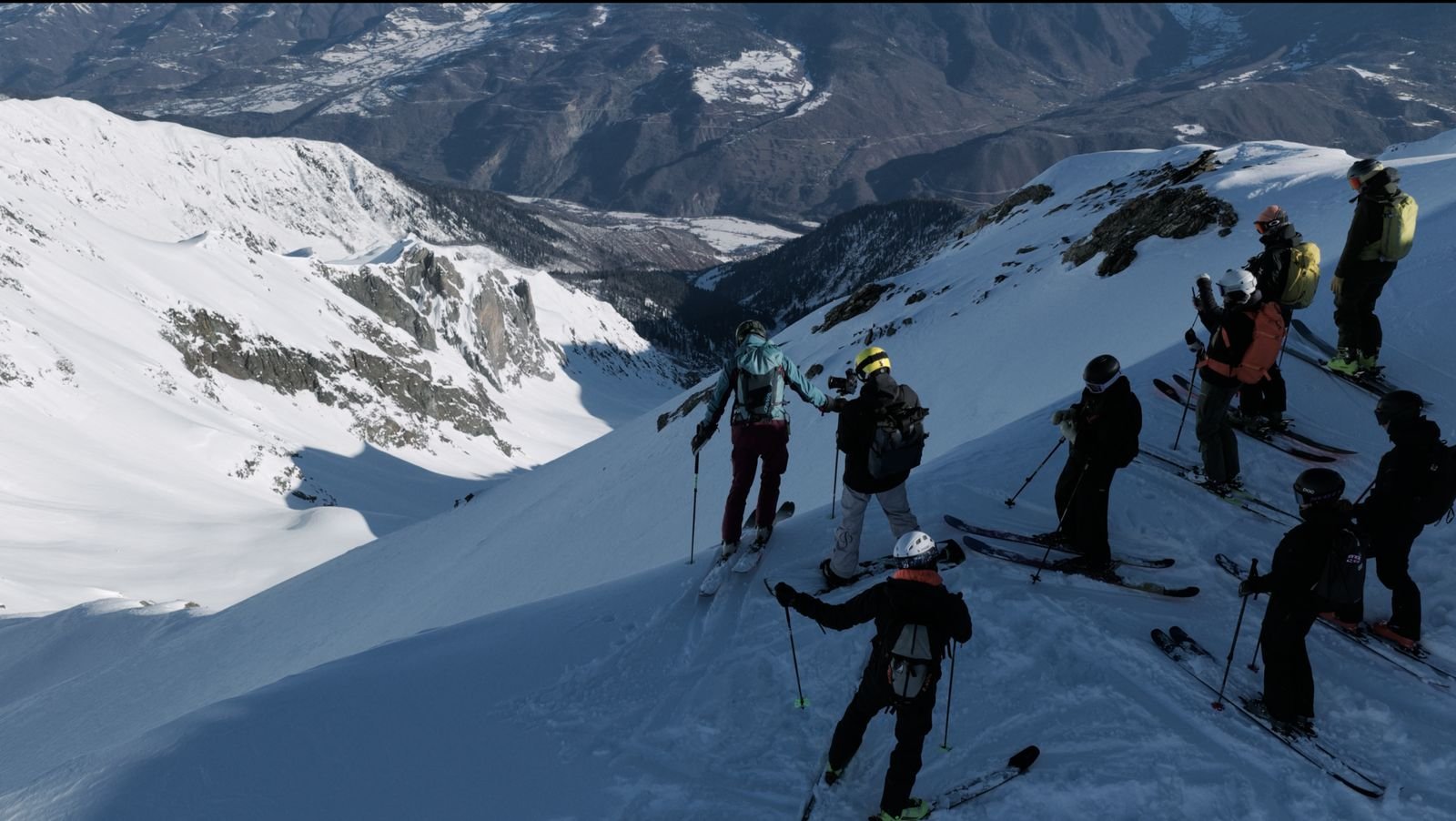
What you ski is decided each morning, not in advance: Tetnuldi's 2,265–3,160 m of lift-served freeride, the forest at Hatsvali when the cloud is down, the Koruldi plateau at about 2,740 m, the touring lines under Ushba in the Becho valley, and the road east to Ushguli at 2,100 m. Weather governs all of it, and we say so before you book rather than after.
The other half of the proposition waits at the bottom of every run. Upper Svaneti was the last self-governed mountain society in Europe, never fully subdued, taxed by nobody, defended house by house from stone towers raised between the 9th and 12th centuries and UNESCO-listed since 1996. Douglas Freshfield, the English alpinist who opened this range to the outside world in 1868, described “a land where every man's house is his castle”. The towers are still standing, still lived in, and you ski down to them at four in the afternoon.
Why Svaneti
What the starting price means for your group
The Classic starting prices — €1,548 for 7 days, €2,238 for 10 days and €3,151 for 14 days — are per person, based on six participants. A smaller private group, a single room or an upgrade needs a separate quote. Solo travellers can ask about a compatible group that is forming.
Before booking flights, agree your arrival and departure dates, the placement of the included nights and the first mountain day. A seven-day programme is not seven ski days. Tell us the experience of each skier or snowboarder, and what equipment you will bring or need to arrange.
Why Svaneti for a multi-day ski holiday
Snow that keeps
Winter trips are generally planned from December to April, but resort opening dates and daily lift hours must be checked with MTA for your visit. Snow varies with storms, wind, temperature, altitude and aspect. Tetnuldi’s base is at 2,265 m; that elevation does not guarantee powder, prevent rain or remove thaw–freeze cycles. We choose the day’s terrain according to current conditions and the group.
Space
Tetnuldi has 13.7 km of marked pistes on five lifts. That is the small part of the mountain. The marked runs are essentially a lift system laid across an open freeride bowl, which is why Freeride World Tour qualifier events are held here and why freeride is a major part of the resort’s appeal. Hatsvali adds 5.5–7 km of runs. The point is not piste kilometres; the point is that on a Wednesday in February you can ski a 600 m face and see one set of tracks on it, yours. Freshfield, returning in 1887 and 1889, wrote of “space, light and shadow”, still the most accurate three-word description anyone has managed.
Two resorts that do different jobs
Tetnuldi is high, open and alpine: 895 m of lift-served vertical, 19 km and about 30 minutes from Mestia. Hatsvali is 8 km from town, 1,868–2,347 m, and its trees hold both dry snow and visibility when the alpine turns into a white room. Having both inside half an hour is the reason a five-day programme here rarely loses a day outright. See the full winter programme for the single-day versions of each.
Culture at the bottom of the run
You finish skiing and you are in a working village, not a resort built to service one. Dinner is kubdari, hand-cut spiced meat baked inside bread and listed on Georgia's register of intangible heritage, and tashmijabi, potato beaten with cheese until it stretches. The towers outside the window are 900 years old and somebody's grandmother lives in the one on the left.
Terrain
The terrain: where you ski in Upper Svaneti
Five areas, all within reach of Mestia, all weather dependent. The morning briefing decides which one you get.
Tetnuldi
2,265–3,160 m · 895 m vertical
The main lift-served area in our Svaneti programme: wide, open, north-tending faces above the treeline, obvious fall-line skiing, and enough choice of aspect to find cold snow days after a storm. Nineteen kilometres and about 30 minutes from Mestia. Freshfield called the peak itself “as high as Mont Blanc and as graceful as the Weisshorn”.
Hatsvali
1,868–2,347 m · 3 km forest run
The storm-day answer: trees give you visibility when the alpine gives you none, and the forest holds dry snow long after the open faces have been worked by wind. Eight kilometres from Mestia, Zuruldi chairlift, panoramic restaurant at the top facing Ushba.
Koruldi
~2,740 m · catski zone
Koruldi is a separate catski area above Mestia. The vehicle has nine seats; the exact allocation is confirmed for the departure. Do not apply Tetnuldi run-count or vertical-metre scenarios to Koruldi. Terrain and access depend on conditions.
Mazeri and Becho
Under Ushba, 4,710 m
Here the programme changes character, from lift-served freeride to ski touring: longer approaches, no infrastructure, terrain judged entirely on the day's snowpack. The Guli Pass at 2,950 m gives the best view of Ushba available to anyone on foot — the mountain Freshfield called “the Caucasian Matterhorn… one Matterhorn piled on another, and then multiplied by two”.
Ushguli
2,100 m · UNESCO core
About 200 permanent residents, snowbound some six months of the year. The church of Lamaria, 9th–10th century, stands above the village with Shkhara behind it at 5,193 m, anchor of the roughly 12 km Bezengi Wall. Access depends on the road, the most weather-sensitive element in any itinerary we run.
The rhythm
How a day runs on a ski expedition
- 07:30
- Breakfast
- 08:15
- Avalanche and weather briefing
- 08:45
- Equipment check
- 09:00
- Transfer
- 10:00–16:00
- Guided skiing
- 17:00
- Return, sauna, relax
- 19:30
- Dinner
- 20:30
- Briefing for the following day
What happens between those timestamps matters more than the times themselves.
At the morning briefing, discuss the available weather and avalanche information, recent observations and the proposed route with your guide. The plan can change or be cancelled as conditions develop.
The 08:45 equipment check is physical. Every transceiver switched on, every transceiver searched for, batteries confirmed, shovel and probe in the pack. It takes six minutes and it is not optional.
The departure time and transfer duration depend on the chosen area, road conditions and the day’s plan. For a lift-served day, confirm the current MTA opening hours and lift status. Touring may require a different start and return time; your guide confirms the schedule.
Between 10:00 and 16:00 the group skis as a group: one at a time through exposed terrain, regrouping at defined points, with the running order changing as light and snow change. Around 1,200 vertical metres in a day is normal; on a good day it is considerably more. These are the same guided freeride days we sell singly, strung together.
The 20:30 briefing is where tomorrow gets decided and where plans change. If the forecast turns, you hear it that night rather than at breakfast.
The team
Your guides: IFMGA and GMGA certified
IFMGA — the International Federation of Mountain Guides Associations — is the highest guiding qualification there is, and the only one recognised across the Alps, the Andes, the Himalaya and here. Reaching it takes years: assessed courses and examinations in alpine climbing, rock, ice, ski touring and avalanche rescue, a personal logbook substantial enough to qualify for entry in the first place, and continuing assessment to keep it current. GMGA is the Georgian Mountain Guides Association, the national body that trains and certifies to that international standard inside Georgia. A guide holding both carries the international qualification and the local mandate.
Local experience is valuable, but it is not a guarantee of safe conditions. Ask who will guide your group, what qualifications they hold and how current observations and available forecasts inform the daily decisions.
The ratio is 4–6 guests per guide, six absolute maximum. Below four the logistics stop working; above six a guide cannot watch everybody in exposed terrain or dig you out quickly enough if something goes wrong. Larger bookings are split across additional guides at the same ratio rather than stretched over one. Guides work in English, carry radios, a first-aid kit and rescue equipment, and are the final authority on the hill. More about how we work.
Safety
Avalanche safety and rescue equipment
Before every mountain day, review current information and the intended terrain with the guide. Do not interpret an unavailable or missing bulletin as evidence of low risk. A commercial itinerary is not a terrain-safety assessment.
Daily assessment
At 08:15 the guide team presents the day's picture: recent snowfall, wind loading and direction, temperature trend, freezing level, and field observations from the previous day. From that comes a decision on which aspects and elevations are in play.
Terrain assessment on the ground
Slope angle, aspect, wind effect, terrain traps below the run, test slopes and hand shears where they tell us something. The plan made at breakfast is a hypothesis and it gets revised at the top of the first pitch.
Mandatory equipment
Transceiver, shovel and probe, checked every morning, no exceptions. Airbag packs are strongly recommended and rent locally.
Turning around
Read this twice. We will cancel objectives, change valleys and occasionally not ski at all. Weather dependent means what it says. A guide who turns a group around below a loaded slope is doing the job correctly, and that decision is never open to negotiation.
Insurance is neither optional nor decorative. Georgia has required medical travel insurance for foreign visitors since 1 January 2026, and for this product you want a policy that names off-piste or backcountry skiing explicitly and includes helicopter evacuation. A standard piste policy will not cover you here.
Freshfield's porters, caught on a fogbound glacier in 1887, prayed to the sun: “they were as persistent as the priests of Baal, but with better success. The mists lightened.” We plan for the days on which they do not.
Base
Where you sleep and what you eat in Mestia
Accommodation is included on all three packages. The default is an authentic Svan guesthouse: family-run, in Mestia, wood-panelled rooms, hot water, a stove, and in most of them a sauna waiting at 17:00. This is not the compromise option. It is why a good number of guests come back. Two upgrades are available: a 3★ hotel for those who want a more conventional private setup, and, on the Ultimate Caucasus Expedition, a boutique property. Both are priced on request — see our mountain hotel in Mestia.
Breakfast, lunch and dinner on programme days. Confirm the meal arrangements for travel days and any dietary requirements before booking.
Dinner is Svan, a distinct cuisine even within Georgia. Kubdari: hand-cut spiced meat sealed inside bread and baked, on Georgia's intangible heritage register. Tashmijabi: potato beaten with young cheese until it comes off the spoon in ropes. Svan salt on most things, ground from garlic, fenugreek, coriander and red pepper. Bread, cheese, pickles, soup after a cold day.
Somewhere in the stay there will be a Svan supra, the Georgian feast, led by a tamada who proposes the toasts and sets the pace of the table. Wine and chacha are not in the package price and are rarely absent from the room. This is a society that governed itself by open assembly for a thousand years, and it shows at dinner: Freshfield noted of the Svan assemblies that “a late comer could reopen the debate”. The same is broadly true of the toasts.
Add-ons
Optional experiences: catski, heli days and Svan culture
Classic and Signature have different inclusions. A catski or heli activity explicitly named in your selected programme is part of that programme; other additions require a separate agreement. Flights and terrain remain subject to operating conditions.
Heliskiing
The obvious addition and the least predictable to schedule: flights need visibility, wind inside limits and a stable snowpack. Book it as an intention rather than a fixture. The longer your package, the better your odds of a window. Heli-assisted descents →
Catskiing
Tetnuldi and Koruldi are different catski areas. Tetnuldi uses a PistenBully 600 for up to 13 riders plus two guides; Koruldi has nine seats. The programme determines whether a catski day is included, as in the named Signature itineraries, or booked separately. Compare catski options.
Horse ski touring
Svan horses tow skiers along the valley floor to the foot of a line. A working local practice rather than a novelty, and the most efficient approach to parts of the Becho terrain.
Paragliding
Tandem flights from the ridges above Mestia, cloud base permitting. Tandem flights →
Photographer and drone
A dedicated shooter who skis at your level, works stills and drone footage through the day and delivers an edit afterwards. Most worthwhile on the 10 and 14-day packages. Films & Photography
Culture and lessons
Towers, the museum treasury and the festival calendar sit five minutes from the guesthouse door. Svan culture and towers → · Ski and snowboard lessons →
Equipment
What to bring: ski expedition equipment checklist
Bring
- Skis or a splitboard with touring bindings; something fat, 100 mm or more underfoot. Skins and poles
- Ski boots you have already walked in
- Avalanche transceiver, shovel, probe, unless you are renting
- A 30–35 litre pack that carries skis
- Helmet, goggles plus a low-light lens, sunglasses
- Waterproof shell and trousers, and an insulated jacket for standing still at −7 °C and below
- Base layers, two pairs of gloves, warm hat, buff
- Sunscreen, lip balm, personal first aid, any medication you take
- Head torch, thermos, spare batteries
- Cash in lari: Mestia has the last ATMs, and the villages are cash only
- A Magti SIM, which has the best coverage in the valleys
We provide
Guiding, group safety and rescue equipment, first aid, radios, daily transport and lift access where required.
Rents locally in Mestia
Skis, splitboards, boots, poles, transceiver, shovel, probe, airbag packs. Send sizes at booking and the kit will be waiting on arrival instead of being sorted out on the first morning. See the rental shop and ski service and tuning.
Nothing here is unusual for backcountry skiing anywhere. The one thing visitors consistently under-pack for is cold: a continental interior in January is colder than a maritime range at the same altitude, and you will be standing still through briefings and regroups.
Logistics
Getting to Mestia
The detailed winter packages include the Kutaisi group airport transfer. If you arrive in Tbilisi or another city, agree that route and any difference in the quote. Train and domestic-flight schedules change: consult the transport guide and the operator for your travel date.
Allow travel margin before the first programme day and before an international flight home. Programme days and accommodation nights need an explicit arrival/departure plan; a flight cancellation does not guarantee an immediate road replacement.
Use the Mestia transport guide to plan connections, then confirm the exact pickup and return arrangements for your chosen package.
Price
What's included in the price
Included
- ✓Accommodation throughout in an authentic Svan guesthouse; 3★ and boutique upgrades available
- ✓IFMGA and GMGA guiding on every ski day, 4–6 guests per guide, 6:1 maximum
- ✓Breakfast, lunch and dinner on programme days
- ✓Welcome dinner and farewell dinner
- ✓Kutaisi group airport transfer; other airports by agreement
- ✓Daily mountain transport
- ✓Lift access where the programme requires it
- ✓Daily avalanche and weather briefing, morning equipment check, group rescue equipment
Not included
- —International flights
- —Travel insurance, which is mandatory
- —Alcohol
- —Personal expenses
- —Extras not named in the chosen programme; personal avalanche equipment and airbag rental are separate
- —Accommodation upgrades
Prices quoted are per person and are starting prices. The final figure depends on package, dates, room type and any upgrades.
Questions
Frequently asked questions
Choose your winter programme
| Programme | Classic ski days | Signature ski days | Details |
|---|---|---|---|
| 7 days | 5 | 6 | View itinerary |
| 10 days | 7 | 7 | View itinerary |
| 14 days | 10 | 10 | View itinerary |
These are planned activity days, not guaranteed weather or ski conditions. Other days include village visits, snowshoeing or snowmobiling and the farewell morning, depending on the programme.
Request dates
Tell us your dates and level.
Fill in the form and we reply within a day with availability, a firm price and an honest view of whether the trip suits you. Prefer to talk? Message us on WhatsApp or email — same reply time.
FAQ
Good to know
01How many ski days are included?+
Classic plans 5, 7 or 10 ski days in the 7-, 10- or 14-day programme. Signature plans 6, 7 or 10 respectively. The other days have different activities; see the detailed itinerary. These are plans, not guaranteed ski conditions.
02What experience do I need?+
Confident skiing or snowboarding in variable off-piste snow and fitness for consecutive active days. Tell us about recent trips and your touring experience so we can assess the fit; a resort warm-up does not make this a beginner programme.
03What if the weather changes?+
The guide may change the order, terrain or activity, including not proceeding when necessary. For a heli component that cannot operate, arrangements include recalculation and alternative activities by agreement. Confirm the terms for your chosen package before booking; an alternative is not automatically free.
04Are meals and avalanche equipment included?+
Breakfast, lunch and dinner on programme days. Personal avalanche equipment is not included; arrange rental separately before arrival.
05Can I join alone?+
You can enquire about joining a group that is forming. A place and a departure are confirmed individually; a displayed starting price does not guarantee availability.