
Svaneti · Georgia
Tviberi and the Lashera Hut: hut-based ski touring in western Svaneti
Most people who ski in Svaneti never turn off at the Tskhumari sign. It is an unremarkable junction on the road between Mestia and Zugdidi, a couple of kilometres short of the much…
On this page
Overview
Most people who ski in Svaneti never turn off at the Tskhumari sign. It is an unremarkable junction on the road between Mestia and Zugdidi, a couple of kilometres short of the much better-known turn into Becho, and the road behind it goes nowhere anyone has heard of. Which is precisely why we keep going back.
Tviberi is a small village on the western side of that road, low in its valley and surrounded by more forest than most of Svaneti has. Above it, at 2,215 m, sits the Lashera Hut — one of only two huts in the region's ski-touring literature, and the reason this obscure valley matters to anyone serious about touring in Georgia. From the village you can ski a gentle thousand-metre lap in the trees on a day when nothing else is skiable. From the hut you can reach a 3,100 m pass on the Svaneti Range in a morning, and in spring commit to a twelve-hour glacier day that is among the biggest ski tours in the country.
We guide here, and we do not publish route beta for people to follow alone — by the end of this page you will see why.
Tviberi in brief
- Elevation: around 1,263 m — one of the lowest touring bases in Upper Svaneti
- Community: Tskhumari, west of the Mestia–Zugdidi road
- History: Princely, not Free, Svaneti — Dadeshkeliani country
- Drive from Mestia: roughly 1 h 30 to 2 h 20, depending on the source and the road
- Mountain hut: Lashera Hut, 2,215 m, skis or feet only — no vehicle access
- Easy tour: Tviberi Forest, 8.5 km, 1,020 m ascent, Easy / S1
- Hard tours: Chizhdi Pass, 3,107 m from the hut; Laila Pass, 3,394 m, in spring
- Season: January–March for the forest, February–April for the passes, April–May for Laila
Where Tviberi is, and why it feels different
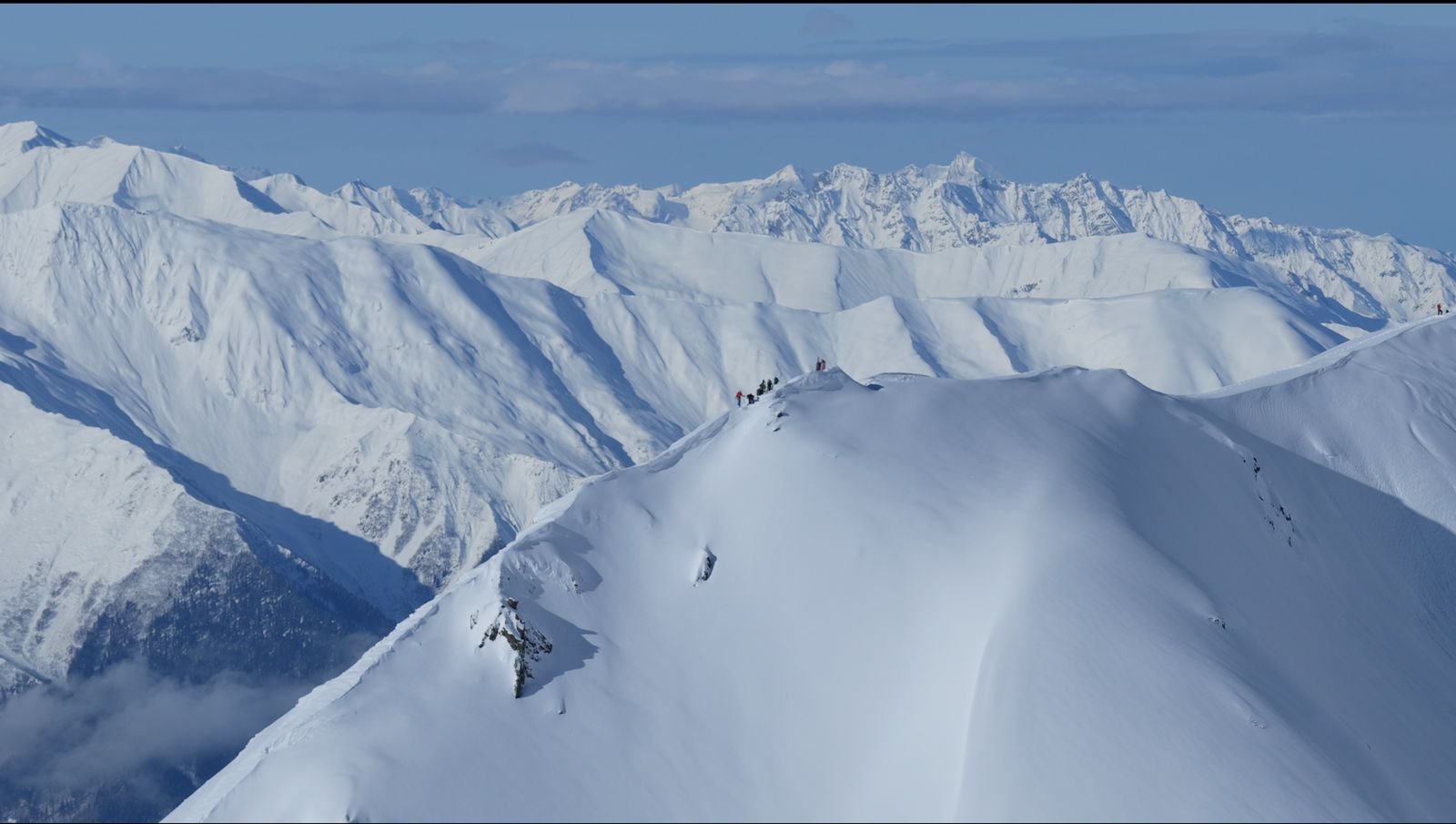
Svaneti divides at Mestia. Head east and you are in Free Svaneti — the communities running up to Ushguli that never accepted a lord. Head west and the history changes: these valleys were held from the fifteenth century by the Dadeshkeliani princes, whose seats lay in the lower gorges toward the Black Sea plain.
That shows in the landscape. Under a prince there was less need for every household to defend itself, so the western villages have fewer towers per family and a looser settlement pattern than Ushguli or Adishi. Tviberi keeps its towers and its old stone-and-timber houses, but they stand in ones and twos rather than dense clusters. Nobody comes here for architecture; it is a small place that mostly farms for its own table.
Tviberi belongs to the Tskhumari community, and as usual in Svaneti the naming works on two layers — communities on the road signs, villages on the bookings. Its neighbours along this side of the road are Becho to the east and Etseri to the west; a week in the western valleys usually touches all three.
The number that defines this valley: 1,263 m
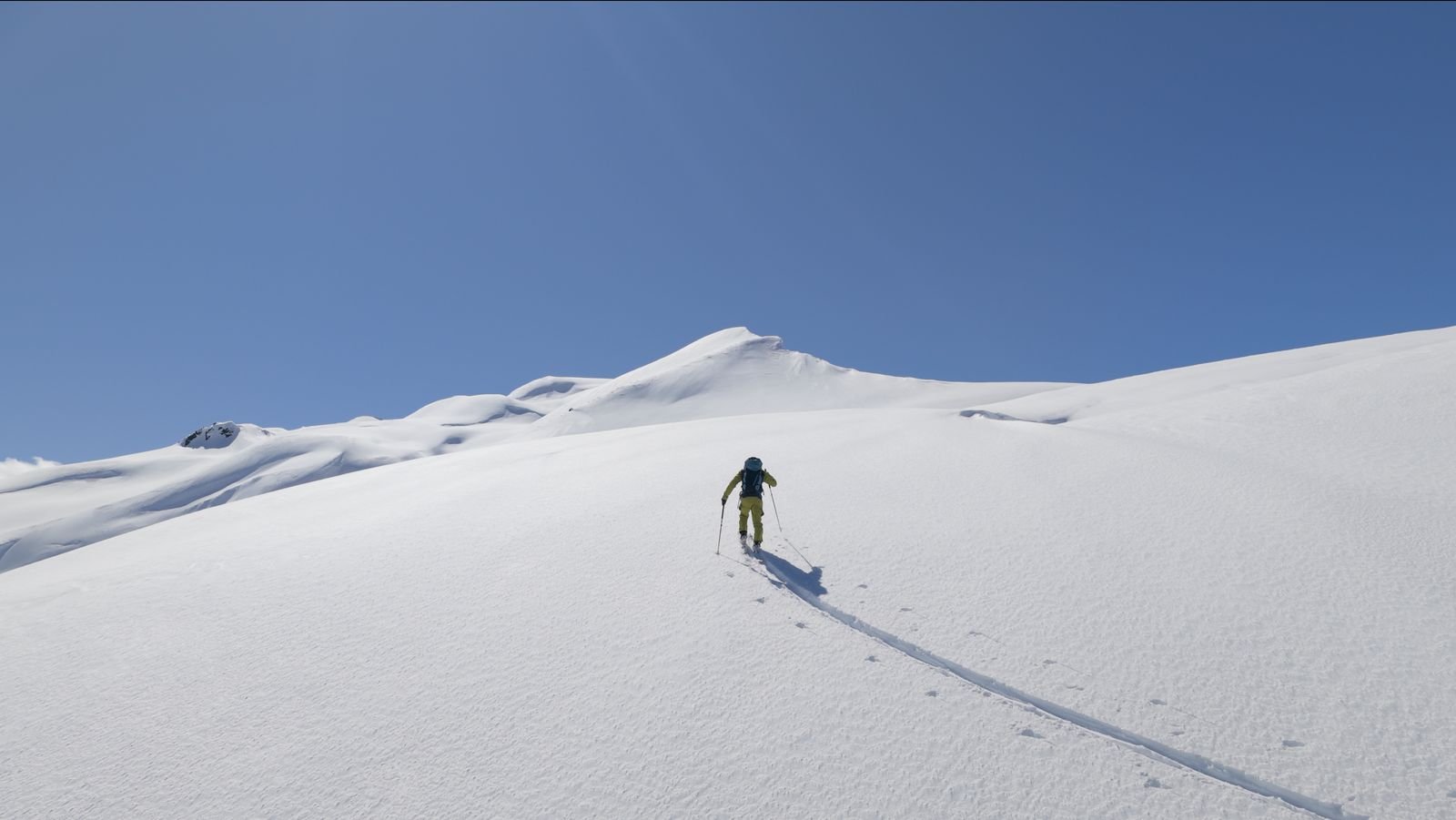
Nearly everything about touring here follows from the village's altitude. At roughly 1,263 m, Tviberi is one of the lowest bases in the regional route catalogue — several hundred metres below Becho or Etseri. In a maritime snowpack, that cuts both ways.
The good half. Svaneti gets a lot of snow: annual precipitation runs from 1,000 mm to well over 3,000 mm depending where you measure. When a February low parks over the range it snows at 1,300 m as heavily as at 2,000 m, and a low, wooded, sheltered valley in those conditions is a gift — soft snow with definition underfoot, trees to see by when the light has gone flat, and angles that do not ask you to gamble on a loaded slope. The forest here faces northeast, which matters more than the altitude: that aspect holds snow cold and dry long after a south-facing forest at the same height has been through its first thaw-freeze cycle.
The bad half. Low means the season ends here first. Valley snow across Svaneti typically starts going in early April, and late spring down here is mud and bare ground while the high country is at its best.
So: Tviberi is a mid-winter valley, not a spring one. If you want western Svaneti in late April, you want to be at the hut looking at glaciers, not in the village looking for a skin track.
The Lashera Hut, 2,215 m
What a Georgian mountain hut actually is
Set your expectations correctly and you will love the place. Set them by the Alps and you will be disappointed within an hour.
There is no guardian, no kitchen service, no half-board and no drying room. A hut in Georgia is a roof, walls, bunks and a stove. You bring your own food, fuel and sleeping bag, and leave it cleaner than you found it. Water is snow melted on the stove, which takes far longer than anyone expects — reckon on a solid hour to hydrate six people for the evening and the day after.
The hut sits on the shelf between the last trees and the open ground running up to the Svaneti Range. What it gives you is not comfort. It is position.
Getting up there
There is no vehicle access. You reach the Lashera Hut on skins or on foot, carrying whatever you intend to eat and sleep in — the single fact that shapes every hut trip we run here. Around 950 metres of climbing separates village from hut, and you do it with a heavier pack than you are used to.
We treat the walk-in as the first day rather than an obstacle to it: leave after breakfast, go at a conversational pace, arrive in early afternoon with daylight left to melt water and sort kit. Groups that bolt an objective onto the carry-in day are tired for the rest of the trip.
Why sleeping high changes everything
The whole argument, in two numbers.
Chizhdi Pass from Tviberi village is a 16 km day: 1,312 m to 3,087 m, 1,849 m of ascent, eight hours of skinning, eleven hours car to car — the longest single day in the western valleys.
Chizhdi Pass from the Lashera Hut is a 6 km day: 2,215 m to 3,107 m, 919 m of ascent, roughly five hours.
Same pass. Half the climbing, less than half the day. That is what a hut buys you in Georgia — not luxury, but the ability to begin a serious objective already standing where the interesting terrain starts. It turns a dawn-to-dark push with no margin for a slow party or a weather change into a normal morning with time in hand. It also buys options: if the snow is wrong on the day you planned the pass, you are not driving home, you are at 2,215 m with another day to use.
The terrain: forest below, big passes above
Tviberi is unusual in offering a genuinely beginner-friendly tour and a genuinely serious one from the same trailhead. Below the treeline it is about as forgiving as Georgian backcountry gets; above it, the ground is committing and a long way from help.
Tviberi Forest: the day that saves a bad week
The valley's easy classic runs 8.5 km from 1,263 m to 2,194 m, about 1,020 m of ascent, maximum angle 28°, on a northeast aspect. It is graded Easy overall, S1 for the descent, E1 for exposure, and is in season January to March. The skin up takes around three and a half hours; the round trip runs between four and a half and six hours depending on which published figure you trust.
On the ground that means low angles, well-spaced trees and a line you can hold when visibility is measured in metres. This is the tour we reach for when the cloud is on the range and the alpine ground is not worth attempting — in a Svaneti February, a lot of days — and where we take strong skiers new to touring, because the consequences here are small.
Tree wells, buried wood and open streams are hazards. The quoted 28° maximum does not establish avalanche safety: assess the whole route, surrounding slopes and current snowpack. Forest terrain is not an automatic alternative for part of a group; any split needs suitable conditions, skills and a clear group plan.
Chizhdi Pass: the same objective, two very different days
From the village (the long way). 16 km, 1,312 m to 3,087 m, 1,849 m of ascent, maximum 32°, northwest aspect, Difficult, S4, E2, Extremely Remote, best February to April. Eleven hours car to car — a full alpine start with a headlamp packed on principle. Cornices sit along the ridge and there are convex rollovers on the climb that deserve respect. The northwest aspect is the compensation: it holds cold snow well into spring, long after sunnier lines have gone to concrete and then slush.
From the hut (the short way). 6 km, 2,215 m to 3,107 m, 919 m of ascent, maximum 38°, northeast, Difficult, S4, Extremely Remote. Five hours. Published exposure figures disagree — one gives High, another E2; we plan for the higher.
That steeper number is not a rounding error. The last 300 vertical metres to the ridge are normally climbed on foot with skis on the pack, so boot crampons and an axe are standard rather than optional. A slide on that northeast face would run the full slope, and there is a cornice on the pass. It is ground to cross before the day warms, and ground we will turn around on without much debate if the snow is talking to us. When the day is right, the reward is 900 metres of northeast-facing snow back into the cirque and, if you want it, the forest all the way to the village.
Laila Pass: the serious spring objective
The big tour out of the hut is a different order of undertaking, and we would rather be plain about it than romantic.
The figures: 17 km, 2,215 m to 3,394 m, 1,812 m of ascent, maximum 33°, all aspects in play, graded Very Difficult, S4, exposure E3, Extremely Remote. Twelve hours, ten of them moving. Season April to May.
The shape of the day: up to Chizhdi Pass, a descending traverse into the Lailachala valley on the far side, a glacier climb to Laila Pass, and home the way you came. You cross and recross the Svaneti Range on aspects that swing right around the compass, so the snow changes character repeatedly and timing matters.
Two things make this guided-only for us. First, E3 exposure means a fall is very likely to be fatal — that is what the grade states, and the modest 33° maximum does not soften it, because exposure describes consequence rather than steepness. Second, there is a glacier. The crevasses on the Laila side are not enormous and in spring they are usually bridged, which is precisely the condition in which people fall into them. Travel is roped, with crevasse-rescue-capable people at both ends, and everyone carries the kit and knows the drill.
Cloud is the real enemy: a whiteout mid-route on a twelve-hour day in Extremely Remote terrain is a serious situation. We run it with experienced ski mountaineers, in settled weather, with a firm turnaround time — see ski touring on Laila for how that trip is structured.
Safety here, stated plainly
Check current avalanche information for the area and date. Check the publication time, geographical coverage and limits of any bulletin or warning. Information for one area or day must not be assumed to cover another. Combine relevant published information with a current route and snowpack assessment; the absence of a warning is not evidence of safe conditions.
The snowpack has a memory. The classic Svaneti problem is an early, thin base that sits through hard December frosts and turns to depth hoar. That layer can persist for months and reacts every time the load or the temperature changes — which is why a slope that skied beautifully in January can be dangerous in March.
Rescue is not fast. Emergency services answer on 112 and there is mobile coverage on many routes, but evacuation from ground like the Chizhdi cirque or the Laila glacier depends on a helicopter that has to be available and able to fly, and it is a paid service — so insurance covering mountain rescue and heli-evacuation is mandatory. In poor weather or after dark there may be no lift-out at all.
How we run a hut-based programme
A Lashera trip is not a day tour with an overnight bolted on.
Warm up in the trees first. We would rather spend a day or two on tours from a village base before committing to a hut. It gets the group moving together, shows us how people ski and transition, and means nobody discovers a boot problem at 2,215 m.
Carry in with a plan. We agree the food, split the group gear and weigh what is going up. Everything you take, you take through 950 metres of climbing.
Two nights minimum, three if you can. One night gives a single shot at an objective. Two gives a second, which in this weather is often the difference between the pass and a story about cloud.
Plan around the sun, not the clock. On the steep upper ground the safe window is early. We start in the dark for the passes and aim to have the committing section behind us before it warms.
Keep an honest turnaround time — announced at breakfast, not negotiated at three in the afternoon on a ridge.
For groups who want the hut experience with less serious objectives, our basecamp trips use the same logic in friendlier terrain, and the ski touring page covers everything we run across the region. If you would rather ride lifts, freeride days are the other end of the same week.
What to pack for a hut trip
The list has three layers, and the first is not negotiable.
Day-tour baseline. Skis or splitboard with touring bindings, boots, poles, skins. Transceiver, shovel, probe — all three, all working, all practised with. Helmet, goggles plus a low-light lens, sunglasses. Ski crampons. Warm mittens and a spare pair. A down jacket that lives in the pack. Headlamp. Sun cream and lip balm, taken seriously in spring. Water, food, first aid and repair kits, ski straps, an emergency tarp or bivy bag. A GPS watch or handheld, because phone batteries die in the cold — plus paper map and compass as the backup that never runs out.
Added for the high passes. Boot crampons and an ice axe, both fitted to your boots. For Laila, the full glacier kit: harness, rope, screwgates, prusiks, ice screws, slings and the hardware for hauling — and the ability to use it under pressure.
Added for the hut. Sleeping bag rated colder than you think. Stove, gas, lighter. Food for the stay plus a spare day. A dry base layer that never gets worn skiing — the best morale item on any hut trip. Cup, bowl, spoon. Warm socks. A power bank: there is nothing to plug into. With space to spare, a thermos, radios for a split group, and a bag for the rubbish that leaves with you.
Flying in without gear is fine — we can sort touring skis, boots and safety equipment through our rental shop. We would rather you started with skins that grip and bases that glide: ski service in Mestia is quick and cheap, and a delaminating skin at 2,900 m is a serious problem, not an annoyance.
Getting to Tviberi
Take the road west out of Mestia toward Zugdidi and watch for the Tskhumari sign, which comes up shortly before the Becho turning — published sources put the gap at both 2.2 km and 2.4 km, so trust the sign rather than the odometer.
Drive time is the other figure sources disagree on: around 1 h 30 by one account, up to 2 h 20 by another. What you get depends on snow, on when the side road was last cleared and on what you are driving, so plan for the longer figure in winter. A 4×4 is sensible — the Mestia–Zugdidi road is normally kept open, but the spur is nobody's clearing priority.
We usually bring people out by private transfer: there is very little public transport pointing this way, and a driver who knows the valley will tell you whether the last kilometre is passable before you commit.
When to come
Mid-winter, the second half of January through March, is the forest season. The low altitude works for you: heavy snowfall reaching the valley floor, a northeast aspect holding it cold, and skiable ground on days when flat light has shut down everything open. Late February into March is generally the strongest stretch of the winter across the region.
February to April is the pass season — more cover on the upper slopes, longer days, and enough stability windows to plan a big objective. The caveat is that from the last third of March the daily freeze-thaw cycle starts, old weak layers wake up and timing becomes everything.
April to May is Laila season, and Laila only. The village is thawing and the forest is finished, but the glacier ground is in condition and the high snow is good on sheltered northern aspects. A spring trip here is a hut trip by definition.
Our guide to the best time to visit Svaneti sets this against the region's wider calendar, and the winter in Svaneti page covers the season more broadly.
Staying in the village
There is modest guesthouse accommodation in Tviberi — the kind of place where the family cooks and there is no reception desk. The listing most often cited has around eight bunks, at a modest nightly rate in winter; rates move from season to season, so verify before you count on it.
Most of our guests base in Mestia, where the choice of rooms and services is far wider, and come out for a day tour or the hut leg. The village wins if you want early starts without a two-hour drive attached.
Who Tviberi suits
It suits you if you already tour, you are fit enough to carry a loaded pack uphill for three hours, you would rather have an empty valley than a lift queue, and melting snow on a wood stove sounds like part of the trip rather than a hardship. It also suits strong skiers new to touring — but only in the forest, and only with a guide.
It does not suit you if you want a comfortable base, reliable signal and a restaurant at the end of the day, and it does not suit anyone chasing Laila Pass without glacier experience or a party without practised avalanche skills. There is no soft version of this valley above the treeline.
If that sounds like too much for a first trip to Georgia, the tours out of Adishi make a gentler introduction.
Ski touring from Tviberi and the Lashera Hut
We are a Svan operator based in Mestia, several of our guides are IFMGA/GMGA certified, and the western valleys are ground we have skied since we were young enough to be carrying someone else's rope. A day in the Tviberi forest when the weather has ruined everything else, two nights at the Lashera Hut with Chizhdi Pass as the objective, or a properly planned spring attempt on Laila — we build it around your dates, your fitness and your experience.
Tell us what you want to ski and we will tell you honestly what is possible — including when the answer is a different valley, a different week, or a different objective altogether.
Nearby
Related
Ski touring
Guided programme
Ski touring Laila
Guided programme
Etseri
Place guide
Becho
Place guide
Basecamp
Guided programme
Plan this with us
Local Svan guides, based in Mestia all year round.
FAQ
Good to know
01Where exactly is Tviberi?+
In western Upper Svaneti, in the Tskhumari community, west of the Mestia–Zugdidi road. The turn is signed for Tskhumari and sits a little over two kilometres before the Becho turning. Driving time from Mestia runs from about an hour and a half to two and a half hours.
02What is the Lashera Hut like?+
Basic and unstaffed. It sits at 2,215 m above the village with bunks and a stove; everything else you bring — food, fuel, sleeping bag, and the patience to melt snow for water. There is no road, so you arrive on skins or on foot.
03Why sleep at the hut instead of driving up each day?+
Because it halves the mountain. Chizhdi Pass from the village is 1,849 m of ascent over eleven hours; from the hut it is 919 m over about five. Basing high also gives you a second chance at an objective if the weather ruins the first.
04Do I need to be an expert to ski at Tviberi?+
Not for the forest: that tour is graded Easy with an S1 descent and a 28° maximum, and suits competent skiers new to touring, with a guide. The passes above are Difficult and Very Difficult, S4, in Extremely Remote terrain.
05Can I ski Laila Pass?+
Only as an experienced ski mountaineer, and only guided. It is a twelve-hour spring day with 1,812 m of ascent, an E3 exposure rating — a fall is very likely to be fatal — and a glacier that must be travelled roped, with crevasse rescue kit and the skills to use it.
06When is the best time to ski here?+
January to March for the forest, February to April for Chizhdi Pass, April to May for Laila. Because the village sits at only 1,263 m, this is a mid-winter valley rather than a late-spring one.
07Is there an avalanche forecast for the area?+
Check whether current avalanche information covers Tviberi and your date; verify the source, issue time and geographical limits. Do not assume either complete coverage or no available information. A current route and snowpack assessment, appropriate avalanche equipment and practised skills remain necessary. Qualified guidance can help manage decisions but cannot eliminate risk.
08What happens if someone is injured up there?+
You call 112, then plan on being self-sufficient for a long time. Evacuation depends on a helicopter that has to be available and able to fly, and it is a paid service, so mountain rescue and heli-evacuation cover on your insurance is essential. In bad weather or after dark there may be no flight at all.