
Svaneti · Georgia
Zhabeshi and Chvabiani: the Mulakhi valley, eleven kilometres east of Mestia
There is a turning on the road up to Tetnuldi that almost every skier drives past. Just before the climb to the pass, a sign points left for Zhabeshi and a smaller road drops away east…
On this page
Overview
There is a turning on the road up to Tetnuldi that almost every skier drives past. Just before the climb to the pass, a sign points left for Zhabeshi and a smaller road drops away east along a river. Take it, and within ten minutes the resort traffic is gone and you are among stone villages where the loudest thing all afternoon is somebody's chainsaw.
This is Mulakhi — the community on the banks of the Mulakhura, about 11 kilometres from Mestia, and the two villages travellers actually name are Chvabiani and Zhabeshi. We are a Svan operator based in Mestia, so we have no commercial interest in sending you out of town. We do it anyway, for two kinds of guest: skiers who want to be closer to Tetnuldi than the town is, and walkers on the Mestia–Ushguli trek who end their first day here and start their second from the same doorstep. What follows is the honest version — what the valley is, what basing here gains you, and what it costs.
Zhabeshi and Chvabiani in brief
- Where: the Mulakhura valley, east of Mestia, in Upper Svaneti
- Distance from Mestia: 11 km (some route descriptions say 12 — both are in circulation)
- Drive time: under half an hour on a normal winter day
- Village elevation: around 1,643 m at Chvabiani
- Community: Mulakhi — 11 villages, roughly 1,200 people
- Historic region: Free Svaneti, the eastern half that had no princes
- Winter draw: Tetnuldi resort, a forest skin track up to it, a ski descent back home
- Summer draw: the Mestia–Ushguli trek, the tower villages, the walk to Lahiri
- Accommodation: family guesthouses in both villages — no hotels
Where the valley sits, and why the names confuse people
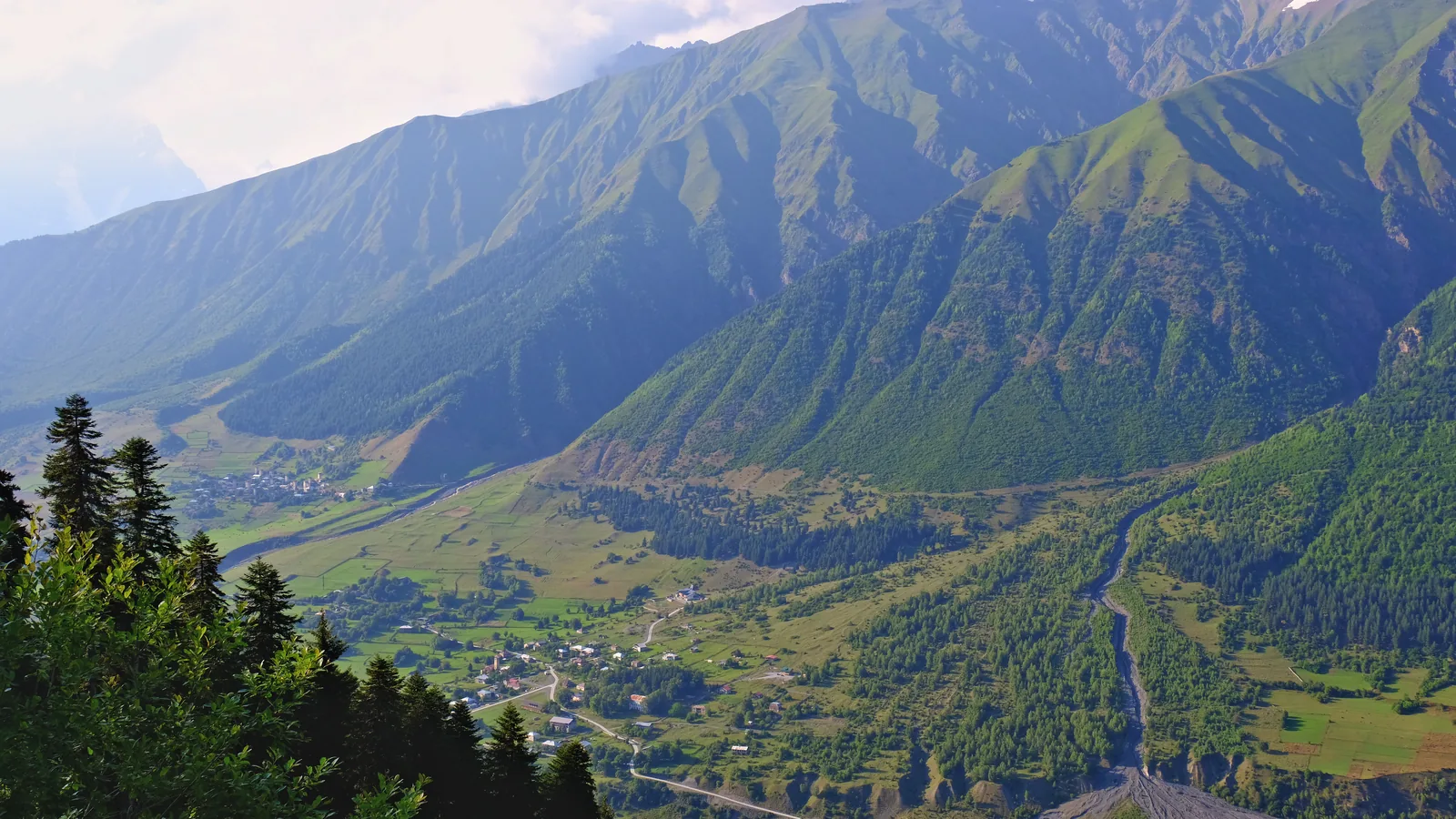
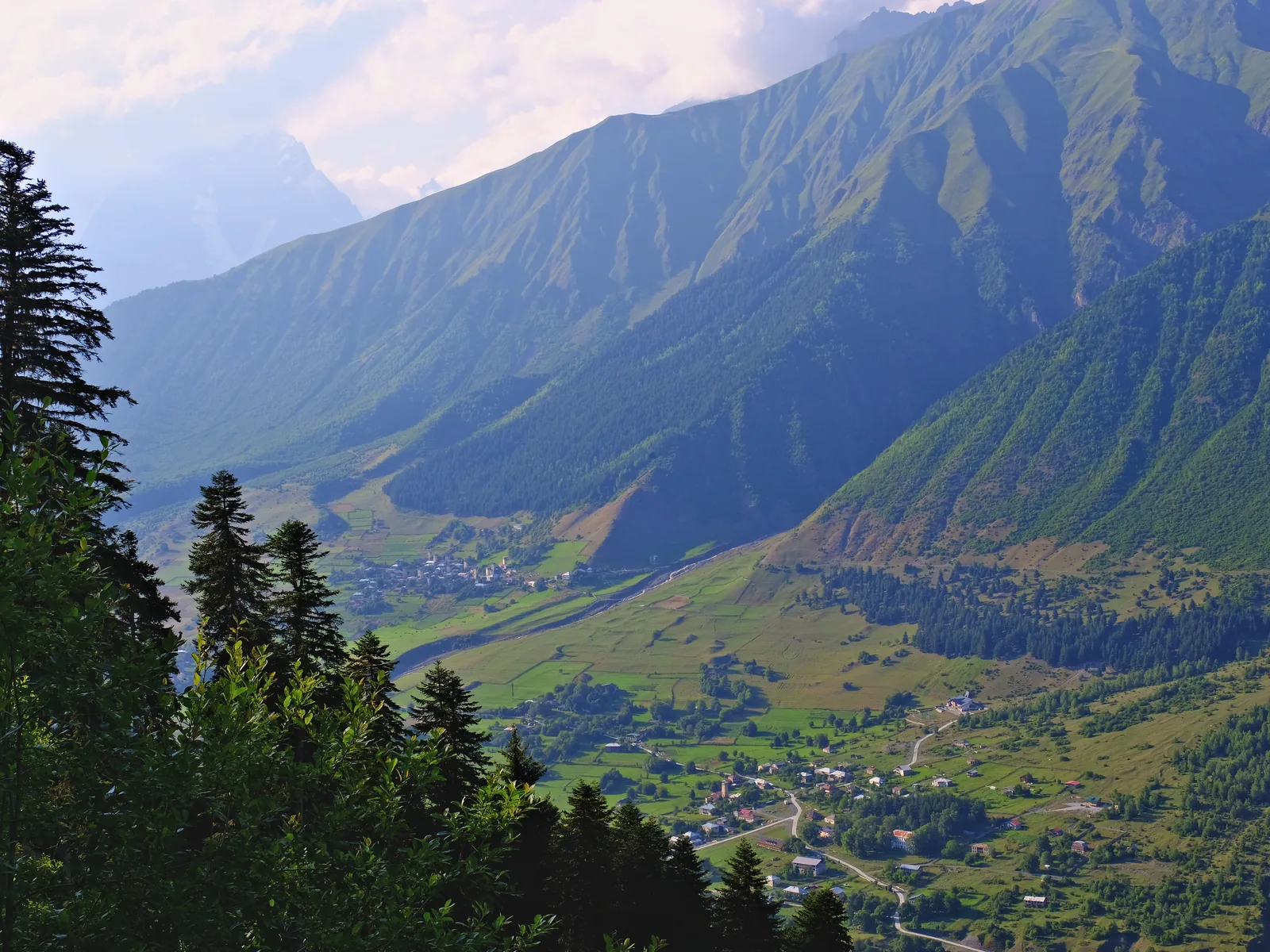
The villages line both banks of the Mulakhura over a short stretch of valley floor, mostly on terraces above the water, with the ridge dividing this valley from Adishi closing the view east.
The naming trips up a lot of visitors, and it is not their fault. Svan villages are administered in groups called communities, and it is usually the community name that appears on signs and maps, not the village. Mulakhi is the community; Chvabiani, Zhabeshi and nine others are the villages inside it. Ask a driver in Mestia for Mulakhi and he knows exactly where you mean; ask a mapping app and you may get one of eleven possible dots.
The eleven villages of Mulakhi
Mulakhi is not one village with satellites. It is eleven settlements spread along five or six kilometres of river, some on the right bank and some on the left, with a combined population of about 1,200: Artskheli, Gvebra, Zhabeshi, Zhamushi, Zardlashi, Lahiri, Majvdieri, Murshkeli, Tsaldashi, Chvabiani and Cholashi.
Nobody expects you to memorise that. It matters for one practical reason: the bank you are on decides your day. Two villages can face each other across two hundred metres of water and still be twenty minutes apart on foot, because you walk down to a bridge and back up the far side.
Twelve hundred people is enough to keep the valley alive rather than preserved. Cattle in the lanes, hay stacked in July, children waiting for the school bus. Not an open-air museum — which is the appeal, and the reason to behave well in it.
Free Svaneti: what "never ruled by princes" meant
Upper Svaneti splits into two halves with different histories. West of Mestia, the valleys fell under princely families, with the taxes and obligations that brings. East of Mestia — across a larger area — the communities were never subject to a prince at all. Mulakhi belongs to that eastern half, alongside Ipari and Ushguli. Historians call it Free Svaneti.
"Free" flatters a hard system. With no lord above them, communities governed themselves through village assemblies and customary law; disputes ran on oath, mediation and, when those failed, on feuds that could take generations to close. There was no outside arbitrator and no garrison to hide behind, so each family built its own defence. That is the whole explanation for the towers: not decoration or status alone, but the architectural result of a society in which a household's security was the household's own problem. When a feud turned violent, the family went up the tower and waited.
It also explains the preservation. Free Svaneti stayed poorer and more remote for longer, and poverty is an excellent conservator of medieval stonework: much of what stands in Mulakhi survived because nobody ever had the money to knock it down.
The towers, and the walk to Lahiri
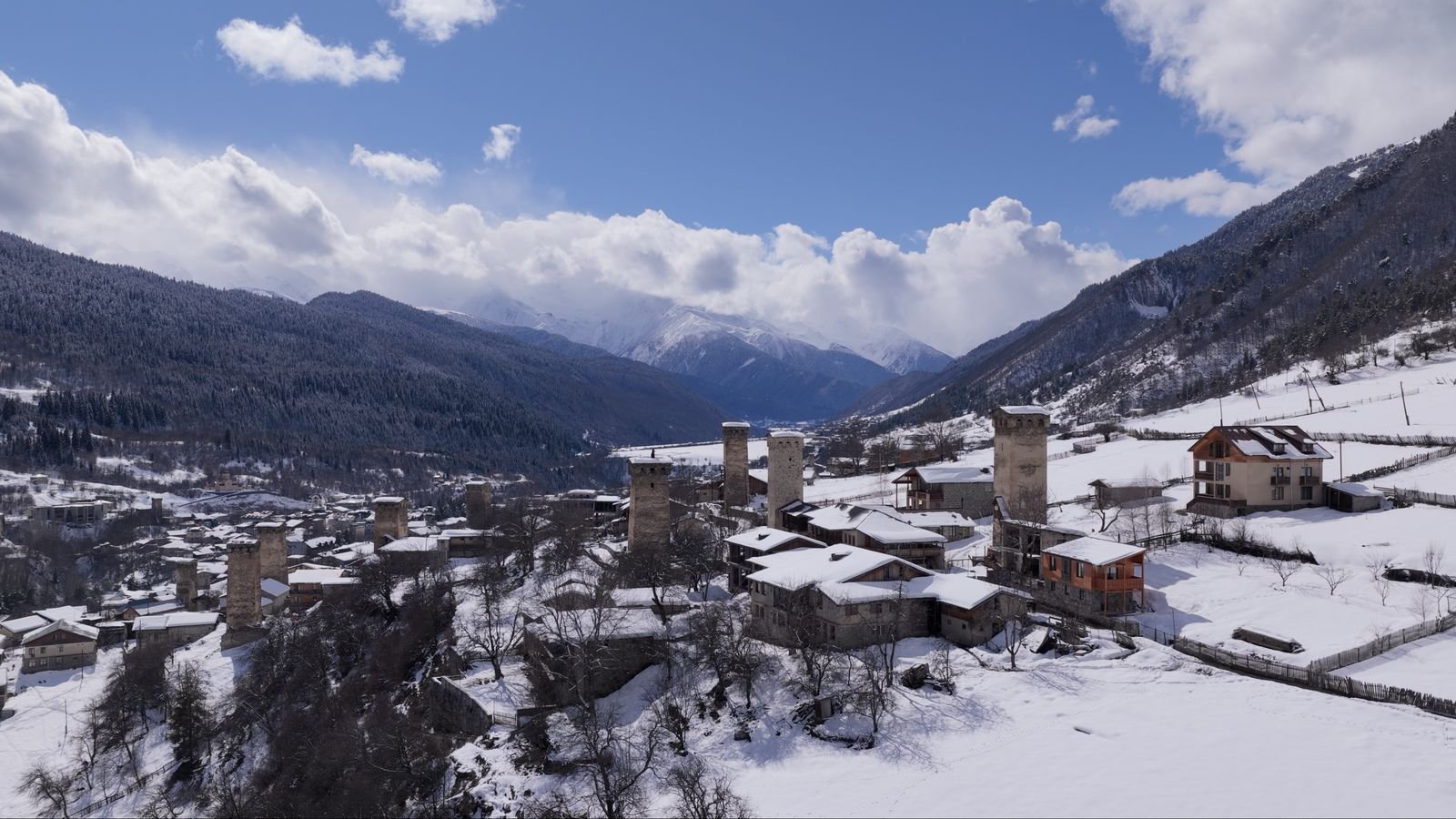
Both Chvabiani and Zhabeshi have medieval tower houses — the tall, tapering family towers Svaneti is known for, most raised between roughly the 9th and 12th centuries, standing alongside the machubi, the old single-hall dwelling that sheltered family and livestock together. The architectural story is on our Svan towers page.
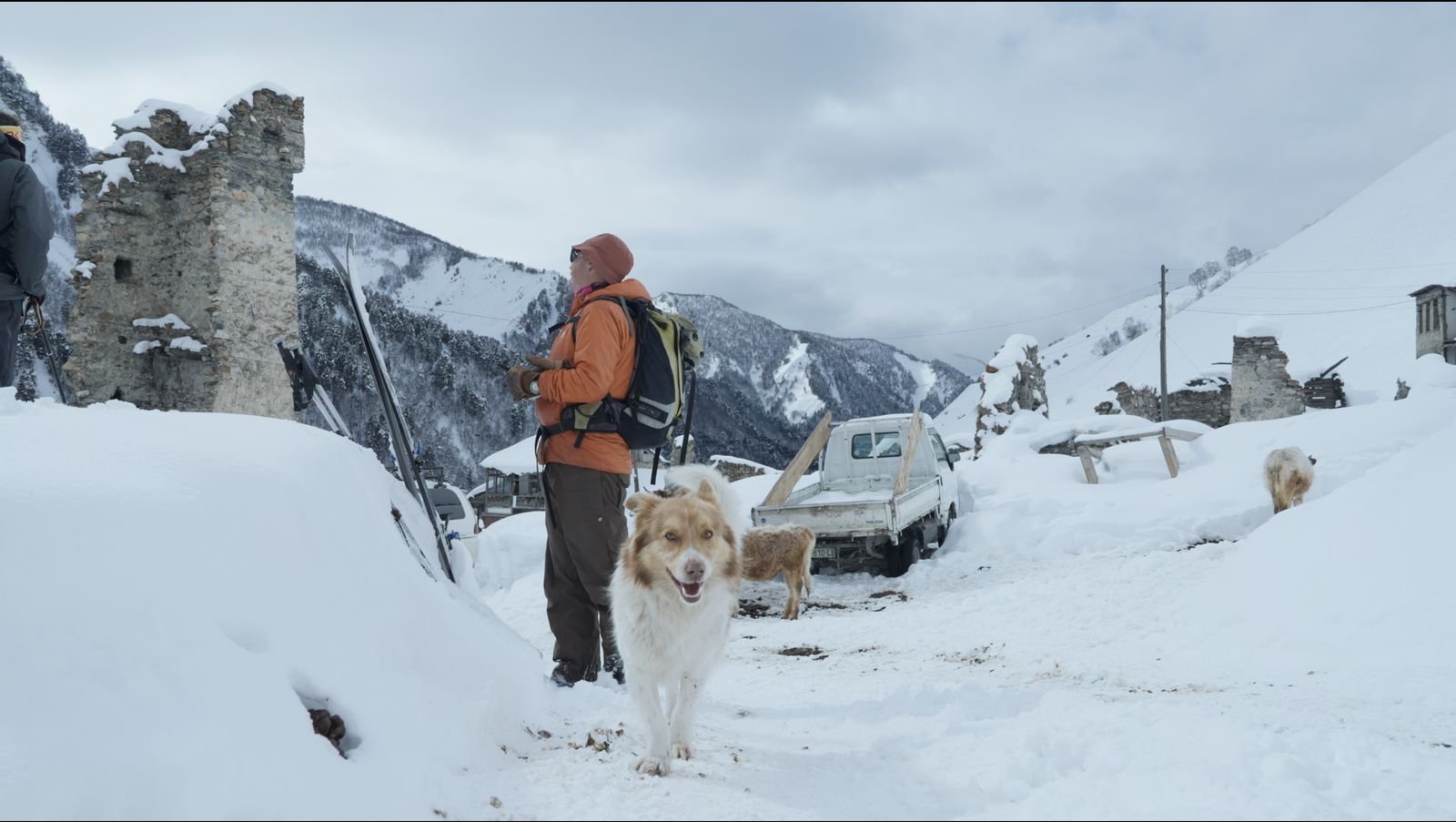
What Mulakhi offers that the famous places do not is the ordinary version: no viewpoint, no ticket office. The towers stand between working sheds and parked tractors, some restored, some leaning, one with a satellite dish bolted to the stone. For many of our guests that beats a perfect skyline.
Half a day to Lahiri
The best walk here for anyone who came for the buildings goes to Lahiri, another Mulakhi village about 5.5 kilometres from Chvabiani on the opposite bank of the Mulakhura, reached by crossing a bridge and continuing up the far side. Allow a half day there and back.
The reason to go is density. Lahiri packs an unusual number of towers into a very small footprint — stone houses tight together, towers rising out of them, mountains behind the cluster. Photographers who have already shot Ushguli often prefer Lahiri, because there are no other photographers in it.
It is a valley and terrace walk rather than a mountain day: no altitude to speak of, no exposure, no navigation problems in clear weather. Winter changes that — in a heavy year it becomes a snowshoe outing.
Basing here for Tetnuldi: the honest comparison with Mestia
This is the decision most winter guests are actually making, so here it is without the gloss.
What you gain
You are closer to the ski area. Mestia to the resort is about 15 km of climbing 4×4 road; the villages sit under the eastern side of the same mountain. You are on snow sooner and the shuttle costs less because it is shorter. Across a week that is real money and real hours.
You get first tracks more often. Groups leaving Mestia arrive in a pulse before the lifts open. Coming up from the valley puts you ahead of it, and on a powder morning the gap between reaching the base at 09:20 and at 09:50 is most of the point of the trip.
Two routes exist only from here. The skin track from Chvabiani up to the resort, and the ski descent back to the village, are both village-side lines. You cannot do either from a hotel in town without first driving out here.
What you give up
Choice. Mestia has streets of restaurants, bars, bakeries, saunas, shops that sell forgotten gloves, a hospital and a police station. Mulakhi has none of it. You eat where you sleep, and you eat what the house cooked.
Flexibility on a bad day. If Tetnuldi is on wind hold or the light has collapsed, from Mestia you can be at Hatsvali in fifteen minutes, or in a museum. From the village, a written-off day is genuinely a day in the village. Bring a book.
Company. If you are solo and hoping to fall in with a group, town is where that happens, not here.
Some road risk. It is short, but it is a mountain road, and after heavy snowfall it takes time to clear. Rarely a problem for more than a few hours, but a tight flight connection on a snowy morning is not something we would plan from here.
We sell nights in both places and would rather put you in the right one. First trip to Georgia, three ski days, a long list of other things to see? We will usually suggest a hotel in Mestia and a shuttle. Here to ski for a week and happy to be off the map at night? The valley wins.
The ski day this valley was made for
One day shape here is among the most satisfying in Svaneti, and it needs a village bed to work.
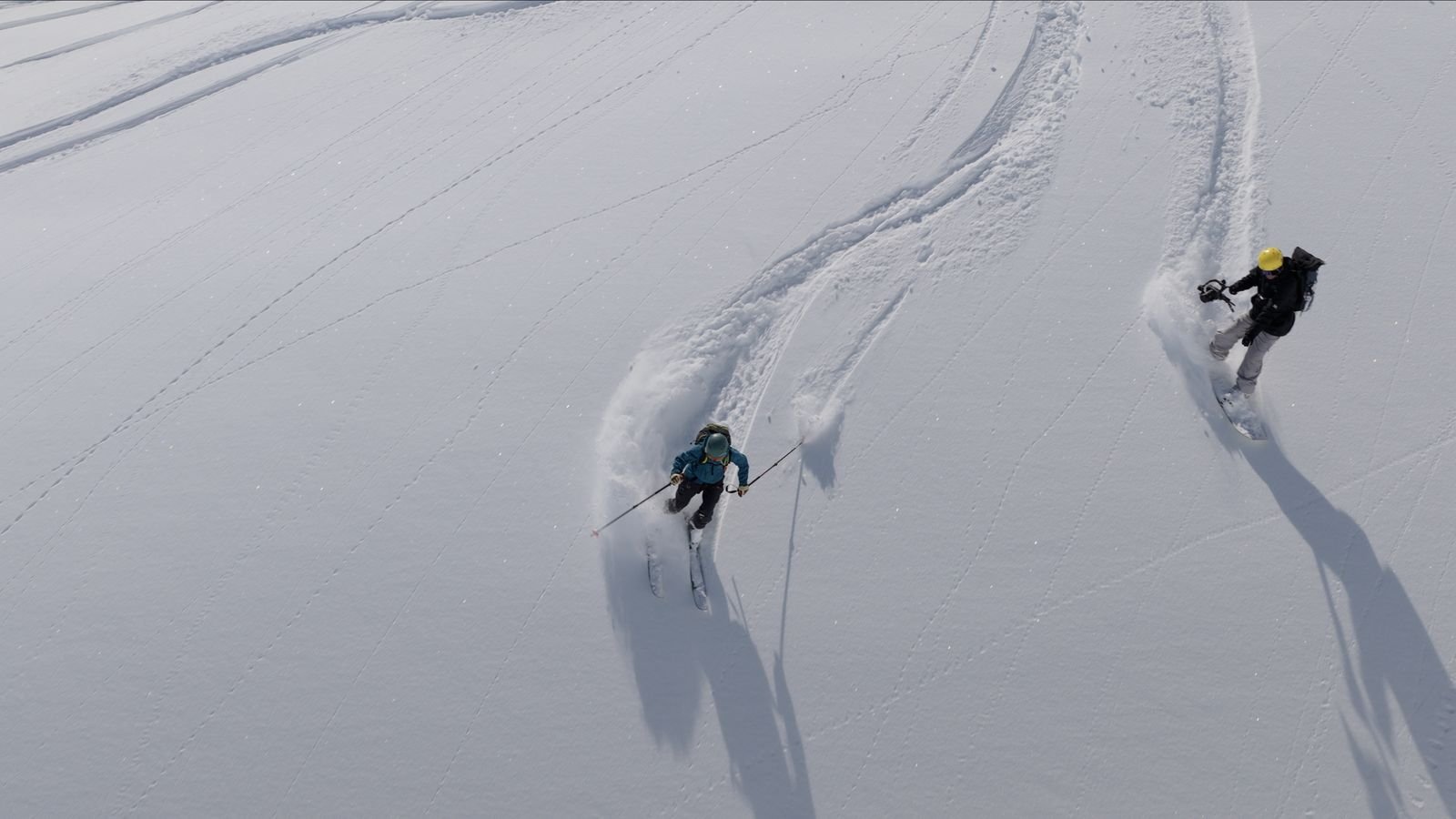
Morning: skin up to the resort. The tour from Chvabiani climbs the forested flank on the village side of the ski area and comes out at the lifts. 5.6 km, 1,643 m to 2,689 m, 1,056 m of ascent, maximum gradient around 25°, west-facing, forest throughout. Graded Easy, descent grade S2, exposure E1 — and, unusually for a touring line, Not Remote, because you are climbing towards a working lift system. Best from January to March. The data card allows about three and a half hours; the climb itself normally takes around two hours at a steady pace.
Midday: ride the lifts with everyone who paid for a taxi. You have already earned your first run and you are warm. There is even a chairlift on the Zhabeshi side, so the mountain's layout points back towards the valley.
Evening: ski home through the forest, on ground you climbed that morning, and have your boots off before the town crowd has finished loading the minibus. No transfer to wait for, no cold half hour in a car park.
Some honest qualifications. It is a forest route, which makes it one of the better options in flat light when the open slopes above are unusable — but tree skiing in poor visibility is not automatically easy, and unfamiliar forest in fading light at the end of a long day is when people get hurt. The gradient is modest, but this is uncontrolled snow outside the resort boundary, and current route and snowpack assessment remains necessary: the assessment is made by the party, on the day, in front of the slope. We run it guided and judge the line against that morning's snowpack; several of our guides hold IFMGA or GMGA certification. See ski touring for how we build these days, or freeride at Tetnuldi and catskiing if lift- and machine-served powder suits you better.
The traverse to Adishi
The other line running off this side of the mountain is the one that gets people's attention: from the top of Tetnuldi resort, across the flanks of the mountain, and down into Adishi — a medieval village of about twenty people that vehicles reach only with difficulty.
The figures: 5.1 km, low point 2,100 m, high point 3,046 m, but only 51 m of actual ascent against 988 m of descent, maximum gradient about 28°, aspect southwest, open terrain. Graded Easy, S2, exposure E1, best in February and March. On paper that reads like a soft day out, and the movement genuinely is straightforward.
The grade describes terrain, not commitment. It is classed Very Remote — round the shoulder of the mountain you are away from the lift system, on open ground, with an isolated village as your only exit. And it depends on visibility: route-finding across open flanks in flat light is slow and error-prone. If the morning is grey, we do something else. We do not start it and hope.
There is also a trap at the far end. The road out of Adishi is not reliably open in winter. The last kilometres into the village are rough at the best of times and slow to clear after snowfall. Before committing a group we check with drivers and with the village whether it is passable, and we plan on the assumption that it might not be — which means either an accepted extra night in Adishi or not going. Being stuck in a Svan village is no hardship; the hospitality is real and the evening will be long. But it should be a decision, not a surprise.
Summer in the Mulakhi valley
The Mestia–Ushguli trek stage
If you have looked at Georgia's most-walked mountain route, you have already met Zhabeshi without knowing it. The classic four-day itinerary ends day one here.
Day one, Mestia to Zhabeshi, is the gentle opener: a valley day on tracks and lanes, farmland, forest edges, villages every few kilometres, not much cumulative climbing. Walkers arrive in the afternoon with legs that still work, which is the point. It is also the day people underestimate the sun, because long stretches have no shade.
Day two, Zhabeshi to Adishi, is where the trek starts properly. It climbs out of the valley through forest to the ridge separating Mulakhi from the Adishi basin: several hours of continuous uphill under trees, a blessing in August heat and a slog in rain. Near the top the forest stops, the ground opens onto pasture, and on a clear day the peaks beyond Adishi appear all at once. Then high meadow, and a descent into the village. Long rather than technical — and you arrive with time to walk up towards the glacier before dinner.
Our trekking season runs roughly mid-June to early October, with July to September dependable. Early June depends on the winter before it; October is beautiful, cold, and thinning out as guesthouses close.
Day walks and slow days
You do not have to be going anywhere. Lahiri and back is the obvious half day. Beyond that, pasture tracks climb out of the valley on both sides towards the summer grazing, and the reward is the view back down at eleven villages strung along one river. Hay season in July and August turns the valley into a work site — meadows cut by hand and small tractor, families out until dark. Watch from the edge of a field rather than the middle of one.
On horseback
Mulakhi is good riding country: valley tracks, shallow gradients, villages close enough that a half day is worthwhile. Horses here are still working animals rather than a tourist product, which shapes the experience — sure-footed, unhurried, led by somebody whose family has used these paths for generations. We arrange rides from the valley, beginners included; see horseback riding.
Staying in a Svan village guesthouse
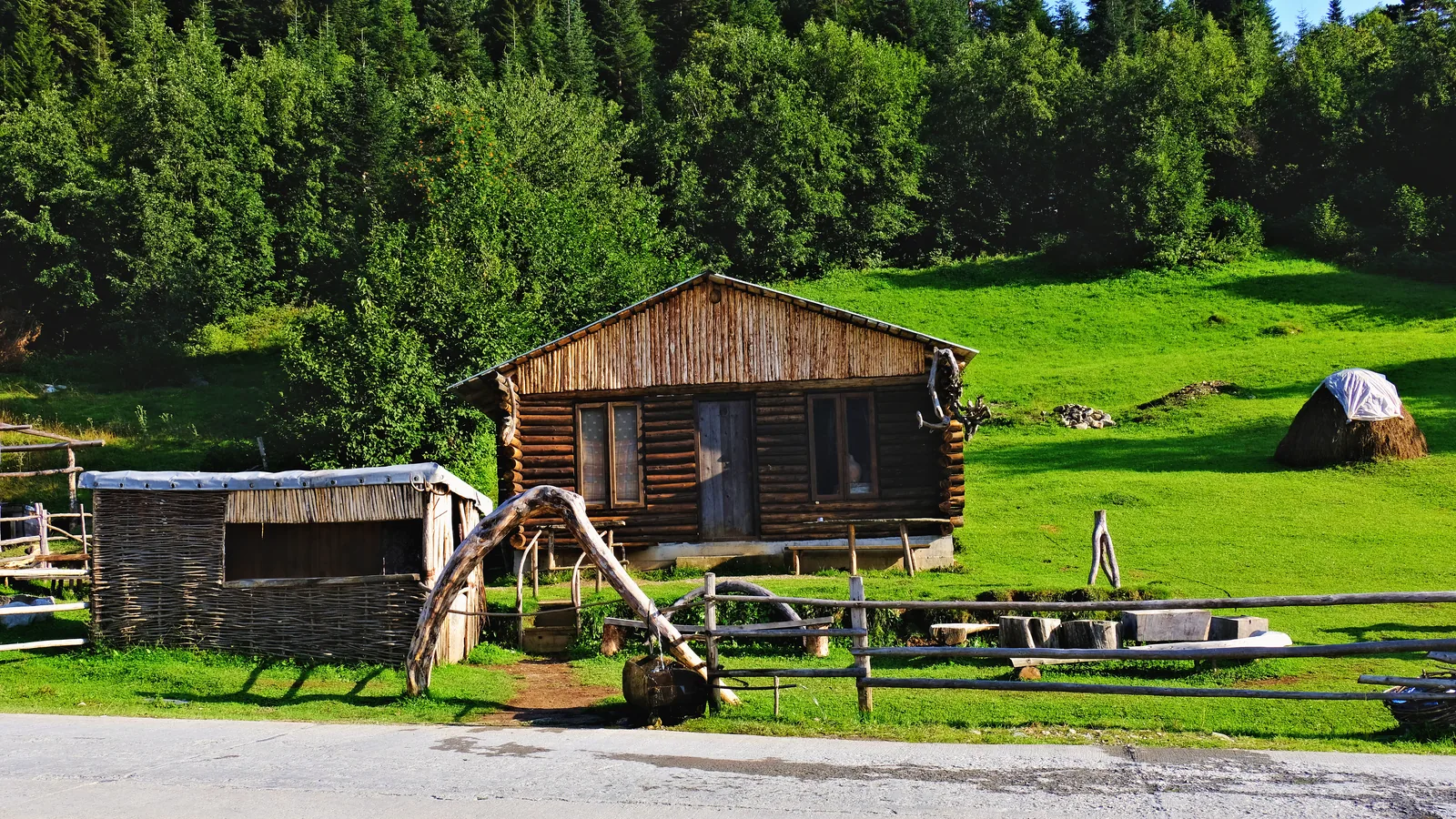
There are family guesthouses in both Chvabiani and Zhabeshi, and nothing else — no hotels, no hostels, no apartments. We do not publish the households' phone numbers here: they are not ours to hand out, and a valley of twelve hundred people does not need midnight cold calls in a language nobody in the house speaks. We book with families we have worked with for years, and we know which houses heat well.
What to expect
Rooms are simple, clean and warm, in a working family home. Bedding is provided; a liner is a comfort item, not a necessity. Hot water depends on the house and the hour. Electricity is real but not immune to storms — carry a power bank. Magti reaches furthest into the mountains. There is no ATM and no card payment in the valley: bring enough lari from town for the whole stay.
Meals are usually included and cooked in the house — bread, cheese, potatoes, beans, preserves, and if you are lucky the Svan dishes worth crossing a continent for: kubdari, the meat-filled bread, and chvishtari, cornbread with cheese through it. Tell us about allergies when you book, not on arrival: there is no shop to solve a problem at eight in the evening.
What the evenings are actually like
Nobody describes this accurately, so: dark, quiet, and you will be in bed early.
Dinner is at the family's table and it is not restaurant service — food arrives when it is ready and keeps arriving after you are full. If the household decides the evening is becoming a supra, it becomes one: toasts led by a tamada in a fixed order, chacha or wine, and a duration unrelated to your plans. Sometimes there is singing, and Svan polyphony at a kitchen table is not something you can buy a ticket for.
Two practical notes. If you are skiing at eight the next morning, say so early and warmly — nobody minds a guest who explains, and everybody notices a guest who vanishes. And if you do not drink, say so at the first toast rather than the fifth.
Otherwise: no bar, no traffic, not much signal. People read, dry gloves over the stove, wax skis and go to bed at ten. After a week in a resort town it is startling how good that is.
Getting there
From Mestia it is under half an hour in normal conditions: east on the Tetnuldi road, then left at the Zhabeshi sign before the climb to the pass, following the river into the valley.
Vehicle: a standard car manages it in summer. In winter it is usually passable but the surface changes with the weather, and the resort road above needs 4WD regardless. We use our own drivers; see transfers.
From Kutaisi, Tbilisi or Zugdidi you travel to Mestia first; allow roughly 4–6 hours from Kutaisi airport, 2.5–4 from Zugdidi, most of a day from Tbilisi. On foot, Zhabeshi is one day's walk from Mestia on the Ushguli trail.
Distance footnote: you will see both 11 km and 12 km quoted, depending on where in the valley the measurement stops. Neither is wrong enough to matter.
When to come
Mid-February to late March is our pick for skiing: deep base, resort fully open, the forest tour in good condition, and the Adishi traverse in season from February. The storm cycles that bring the deepest snow also bring the flattest light — exactly when a forest route is the right answer.
January is colder and quieter, often excellent, with the winter's smallest crowds. December is a gamble while the base establishes itself and thin cover hides rocks. April brings spring conditions: warm valleys, corn snow high up, rising avalanche risk as the snowpack cycles through freeze and thaw each day. June to early October is the walking season, with July to September the reliable core; May and November fall between everything. More detail on our best time to visit Svaneti page.
Who should base here, and who should stay in Mestia
Base in Mulakhi if you are here mainly to ski Tetnuldi; if you are a ski tourer who likes earning the first run; if you are a family or group travelling together; if you are walking to Ushguli; or if you know Svaneti already and want it without the town.
Stay in Mestia if it is your first visit and you want museums, restaurants and both ski areas in reach; if you are solo and want company in the evenings; if anyone needs a pharmacy nearby; or if eating every dinner at the same table sounds like an obligation.
Do both if you have a week. Several nights in the valley for the skiing, then two in town at the end, is the itinerary we build most often and the one guests come back happiest from.
Stay in the Mulakhi valley
We live and guide in these mountains, and this valley is where we send guests who want the skiing without the town. We can put you in a guesthouse in Chvabiani or Zhabeshi with transfers to the lifts, run the forest tour and the evening descent as guided days, take a strong group across to Adishi when visibility and the road allow, or slot Zhabeshi into a Mestia–Ushguli trek. Tell us your dates, and we will say honestly whether the village or the town suits you better. Get in touch and book with us.
Nearby
Related
Tetnuldi
Place guide
Adishi
Place guide
Mestia–Ushguli trek
Guided programme
Mestia
Place guide
Ski touring
Guided programme
Plan this with us
Local Svan guides, based in Mestia all year round.
FAQ
Good to know
01Where is Zhabeshi?+
Zhabeshi is a village in the Mulakhi community of Upper Svaneti, Georgia, on the Mulakhura river about 11 kilometres east of Mestia — under half an hour by road. It sits below the eastern side of the Tetnuldi ski area and is the standard first-night stop on the Mestia–Ushguli trek.
02Is it better to stay in Zhabeshi or Mestia for skiing Tetnuldi?+
The valley is closer, so transfers are shorter and cheaper and you reach the lifts ahead of the town crowd. Mestia has restaurants, shops, both ski areas and everything a bad-weather day needs. Ski-focused trips do better in the valley; first visits with a broad itinerary do better in town.
03Can you ski from Tetnuldi resort down to the village?+
Yes — that is the main reason to base here. A forest line links Chvabiani with the resort: 5.6 km, 1,056 m of height gain, skinned up in about two hours and skied back down in the evening. Graded Easy and S2, best January to March. We run it guided: it is outside the resort boundary, and current avalanche-information coverage must be checked for the route and date.
04How hard is the ski traverse from Tetnuldi to Adishi?+
The movement is easy — 5.1 km, only 51 m of climbing against 988 m of descent, maximum gradient around 28°, graded Easy and S2, best in February and March. The commitment is not. It is classed Very Remote, it needs good visibility, and the road out of Adishi can be closed by snow. Confirm the road first, or plan for an extra night.
05What is there to see in Chvabiani and Zhabeshi?+
Medieval Svan tower houses in both villages, in ordinary working surroundings rather than arranged for viewing. The best outing is the half day to Lahiri, 5.5 km away across the Mulakhura by bridge, where the towers cluster tightly in a small area.
06What is the Mulakhi community?+
The community Chvabiani, Zhabeshi and nine other villages belong to: eleven settlements over five to six kilometres of valley, split between the two banks, population about 1,200. Signs and maps often show the community name rather than the village.
07Is Zhabeshi on the Mestia–Ushguli trek?+
Yes. Zhabeshi ends day one out of Mestia — a gentle valley stage — and begins day two, the forested climb to the ridge and over into Adishi. The season runs roughly mid-June to early October.
08Are there hotels in the Mulakhi valley?+
No. Accommodation is family guesthouses, with meals cooked in the house and included. There is no hotel, no ATM and no card payment, so bring cash in lari from Mestia. We book with families we have worked with for years and do not publish their contact details.