
Svaneti · Georgia
Svan Towers: Why Our Villages Are Built of Stone
Drive up the Enguri gorge on a clear morning and the first tower appears before you have finished taking in the mountains behind it. Then another.
On this page
Overview
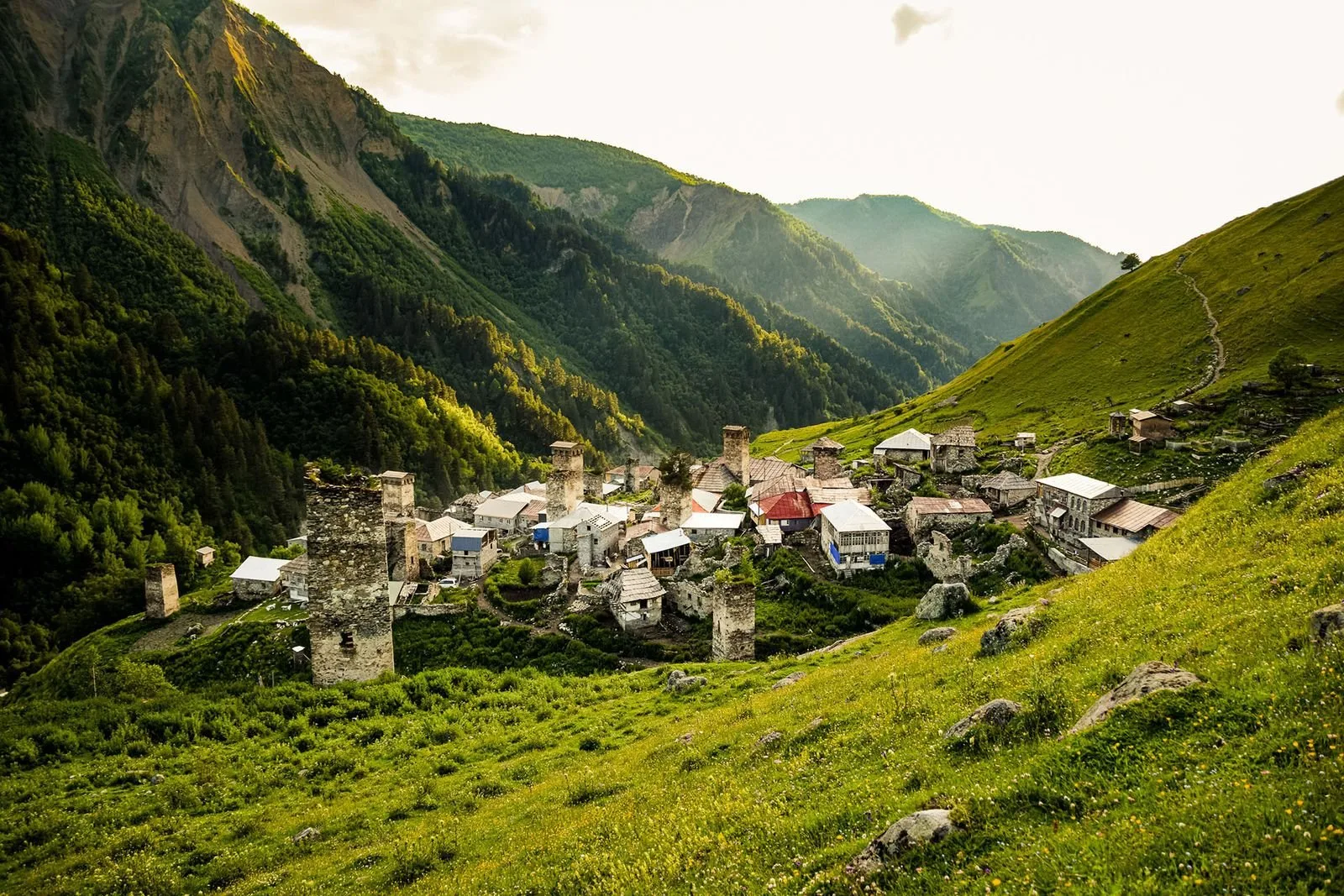
Drive up the Enguri gorge on a clear morning and the first tower appears before you have finished taking in the mountains behind it. Then another. Then a whole village of them, grey and square and slightly tapered, standing among the hay barns like old trees. Visitors reach for comparisons — San Gimignano, an Irish round tower, a chess set left out in the snow. None is quite right. These are not fortresses built by a state, nor monuments built for display. Every one was raised by a family, for that family, against a specific set of dangers.
We are guides from Mestia and Svan is our first language, so the towers are not a curiosity to us; plenty of us grew up in a house attached to one. This page covers what a Svan tower is, when and why they went up, how they work as buildings, and — the part most guides skip — where to go to see the best of them. For the wider picture, start with our overview of Svaneti.
What a Svan tower actually is
In Svan we say koshki for the tall stone tower itself and machubi for the dwelling beside it. They are two halves of one idea, and understanding the pair is the key to everything else you will see.
The machubi is the house: a broad, low, thick-walled stone hall where a family lived on the ground floor together with its cattle, sheep and pigs through a winter that could last five months, with sleeping and storage rooms above. It is designed around heat, hay and survival, not privacy.
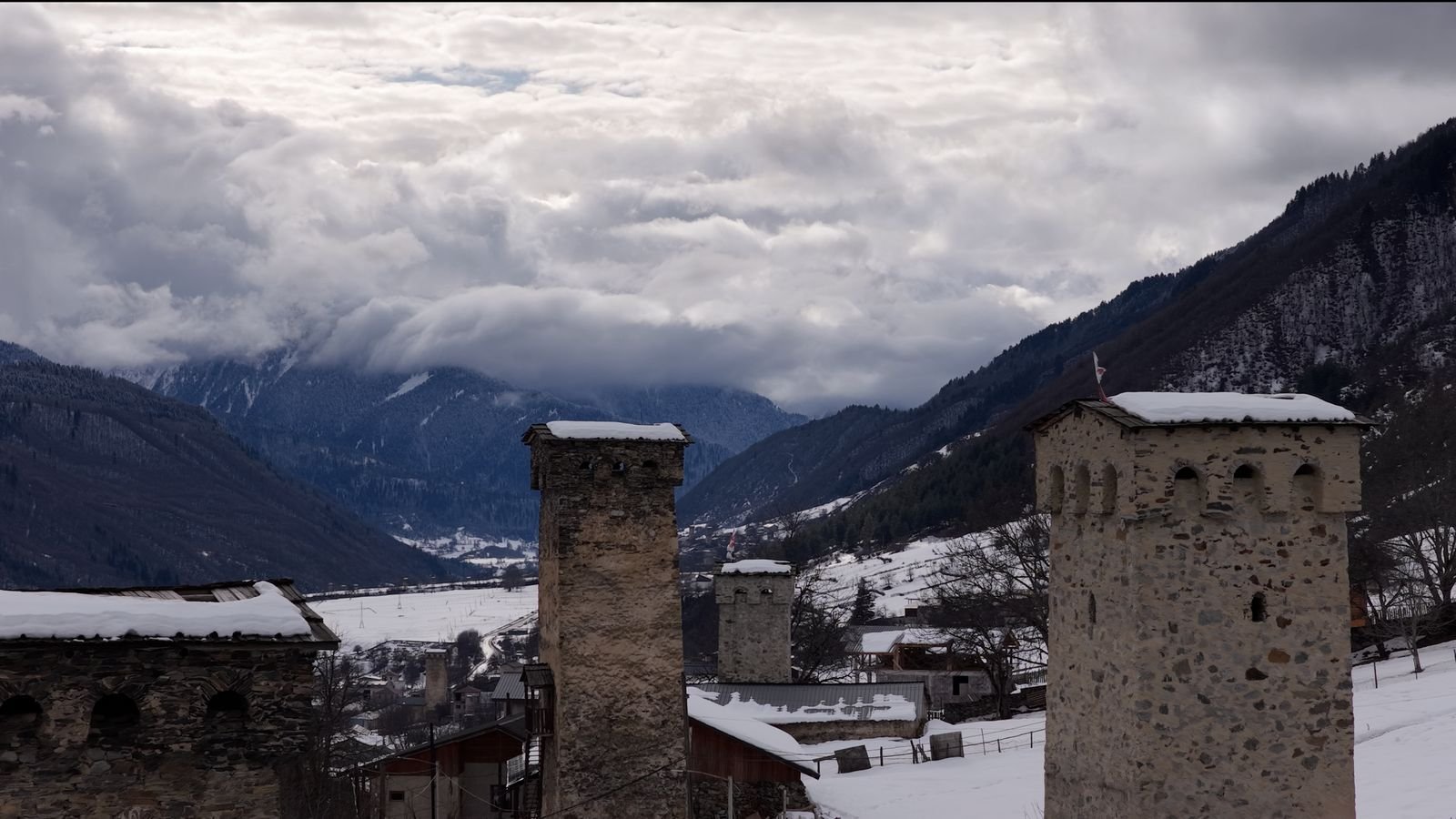
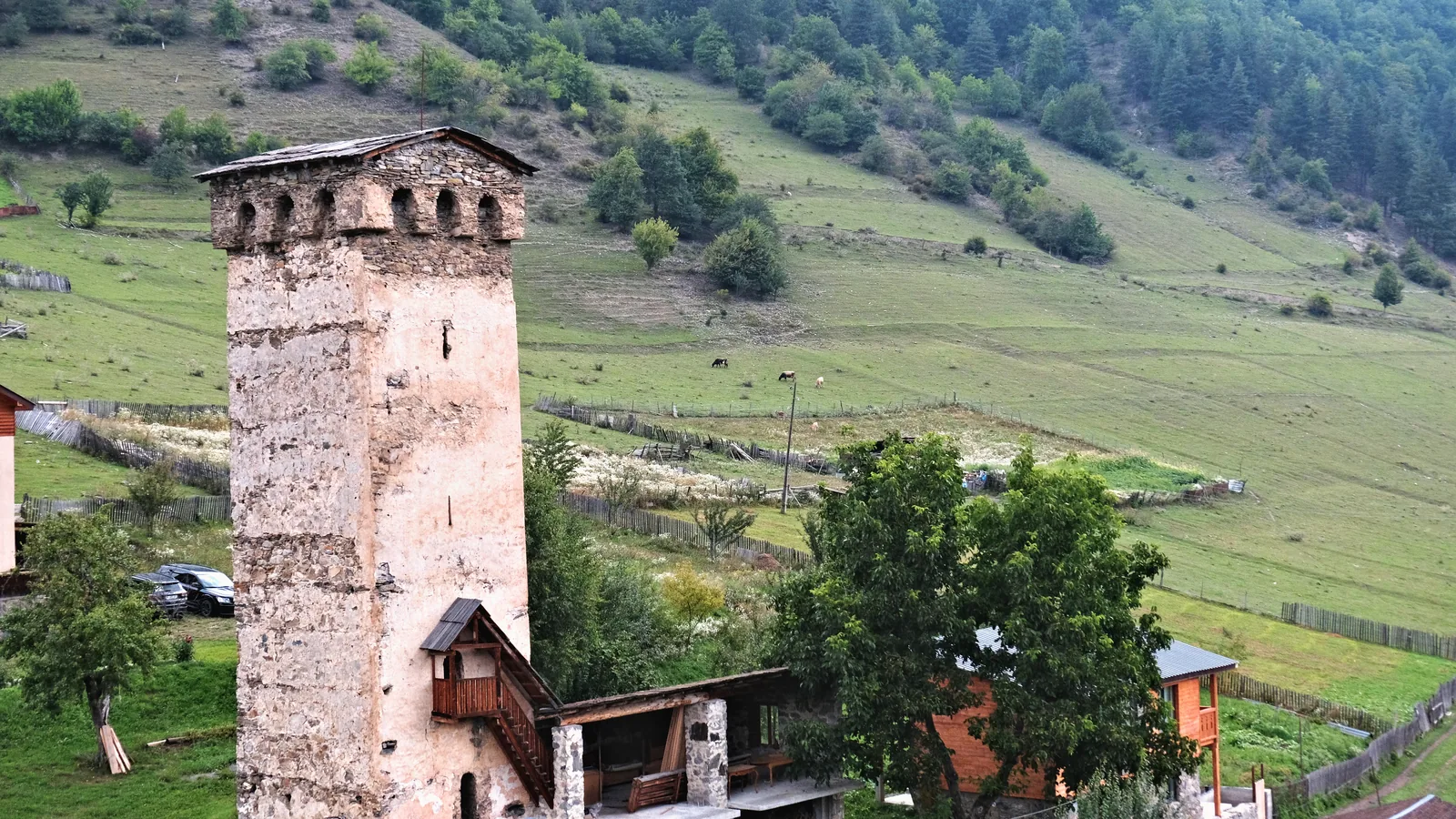
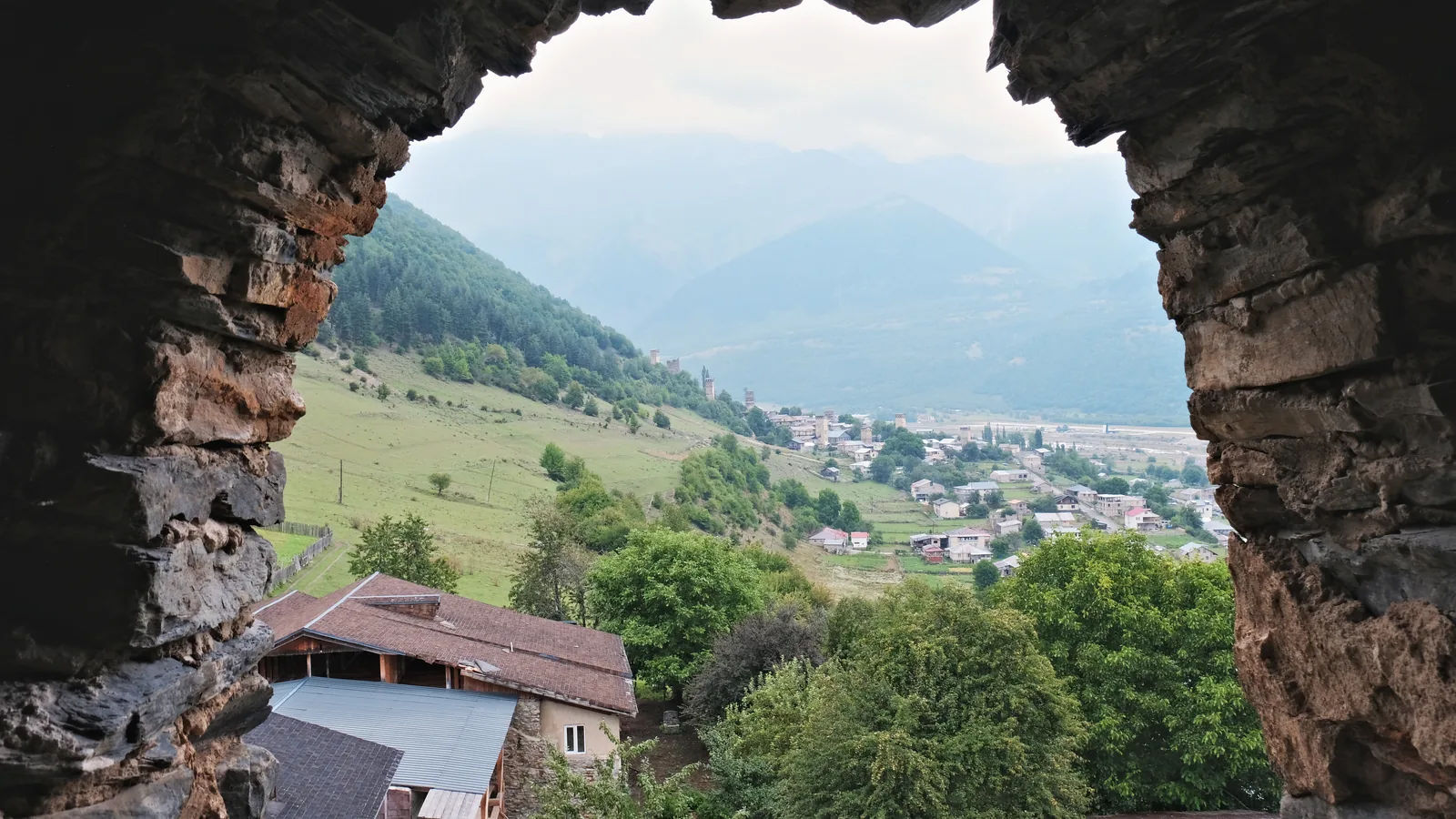
The koshki rises from — or immediately alongside — that house, usually linked by a low door at first-floor level so you could reach the tower without going outside. It is a square shaft of stone laid in lime mortar, narrower at the top than the base, divided inside into four to six wooden floors reached by ladders and hatches. The tallest reach roughly twenty metres, about sixty-five feet, though most are shorter. The top floor opens into a fighting gallery with arched embrasures on all four sides, under a low cap of stone slabs.
So a Svanetian tower house is not one building with a tower attached. It is a self-contained defensive homestead — living quarters, byre, granary, cellar, lookout and last redoubt — built by one extended family, on their own land, with stone from their own slope. That the defence was private is what makes Svaneti different from almost anywhere else in the Caucasus.
When the towers were built, and why
The great age of tower building in Upper Svaneti ran through the 9th to 12th centuries, with the oldest surviving fabric, in Ushguli, reaching back to the 9th. Many towers were repaired, heightened or partly rebuilt much later, so think of a Svan village as something that accumulated over eight hundred years rather than a design executed in one generation.
Why build them? Guidebooks give one answer — invaders — and one answer is not enough. Three pressures worked together, and they were not equally important.
Raiders from the passes
Upper Svaneti sits in a pocket behind the Svaneti Range with the Main Caucasus watershed above it. That geography kept large armies out, but not small parties. Raiding groups came over the northern passes and, in bad periods, up the gorges from the lowlands. Ten or twenty men could not besiege a tower; they could only ride through, take livestock and leave. A tower answers exactly that. You do not need to win — you need to be unattackable for two days.
The mountain itself
Less romantic and equally real: avalanche and rockfall. Svaneti takes one to three metres of precipitation a year and holds enormous snowpack. A stone tower with a small footprint, tapering walls and a wedge of masonry facing uphill survives what a timber house does not. Notice where towers stand in Ushguli or Adishi: on rock spurs, moraine knolls and the upslope edges of terraces — the places a mountain engineer would pick today.
Litsvri: the blood feud, and the reason a tower faces inward
This is the thread that explains more than the other two combined, and the one we take most care over when we guide.
Free Svaneti had no lord, no court, no prison and no standing force. Justice was the clan's responsibility, and its ultimate instrument was Litsvri — the obligation of blood revenge. If a man of your family was killed, his male relatives were bound by honour to take a life in return from the killer's family. It is closely comparable to the vendetta of Corsica and Sardinia: not lawlessness but its opposite, a slow, formal, terrifyingly consistent deterrent in a society with no other enforcement.
The architectural consequence is direct. A family under Litsvri could be attacked not by strangers from beyond the passes but by neighbours two hundred metres away, whose fields adjoined theirs. Feuds ran for years, and during them the men withdrew into the tower, sometimes for a whole season, provisioned from below by the women, who were not targets under the code.
That is why the towers stand so close together, why they cluster within a single village, and why so many embrasures command the lane, the roof of the next house and the path to the spring rather than the horizon. A Svan tower is not only a fortress against the outside world. It is a refuge from the people you live with. Once you have that in your head the villages read differently, and the odd details — the position of doorways, the height of the first window — make sense.
Feuds were ended as well as fought. Mediation by elders, compensation in cattle and land, ritual reconciliation and marriage between the two families were all part of the same system. That side of it survives in the ceremony of a Svan supra, where the order of toasts and the authority of the tamada descend directly from clan diplomacy.
A society with no lord's castle
In most of medieval Europe defence was centralised: peasants worked the land and one aristocratic family built one castle that everybody sheltered behind. Free Svaneti never adopted feudalism. Society stayed organised by clan and community assembly, land was held by extended families, and elders — the makhvshi — mediated disputes by consent, not by right of rule.
Take away the lord and you take away the single castle. What replaces it is exactly what you see: dozens of small private fortresses in one settlement, each belonging to a household, each roughly the size of its neighbours because no family had the surplus labour to build much more. The skyline of Ushguli is a diagram of a society without hierarchy. There is more on this in our notes on Svan culture.
Princely Svaneti and the Dadeshkeliani
West of Mestia the picture changes, and the change is visible in the buildings. Those valleys — Lenjeri, Becho, Tskhumari, Etseri and on toward the lower gorges — were Princely Svaneti, held from the 15th century by the Dadeshkeliani family. Here there was a lord, tribute, and a hierarchy that organised defence from the top down.
The result: fewer towers per household, size and quality concentrated in a handful of princely structures, and a settlement pattern that spreads loosely across the slopes instead of huddling. Drive west from Mestia and you will still see towers, but not the packed clusters of the east. The difference is not aesthetic — it is political history in stone.
Inside a tower: how it is built and how it worked
Construction is deceptively simple and extremely well judged. Walls are local schist and river cobbles laid in courses and bedded in lime mortar, with the best-squared blocks at the corners. The wall is thickest at the base — often well over a metre — and thins as it rises, which is why the profile tapers. That taper is structural, not decorative: it lowers the centre of gravity and lets the tower flex slightly rather than crack. These buildings have stood through a millennium of Caucasian earthquakes without steel or concrete.
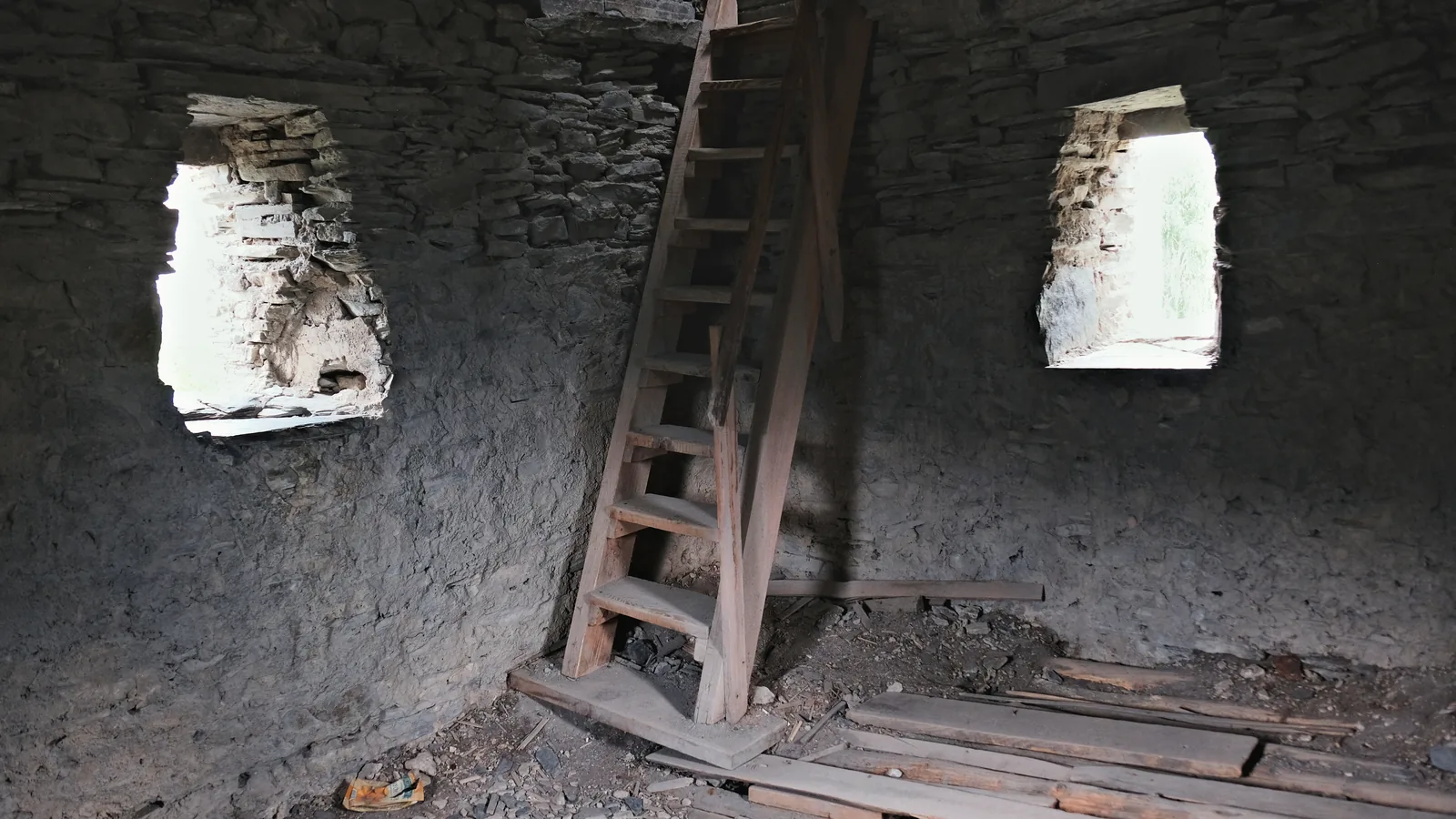
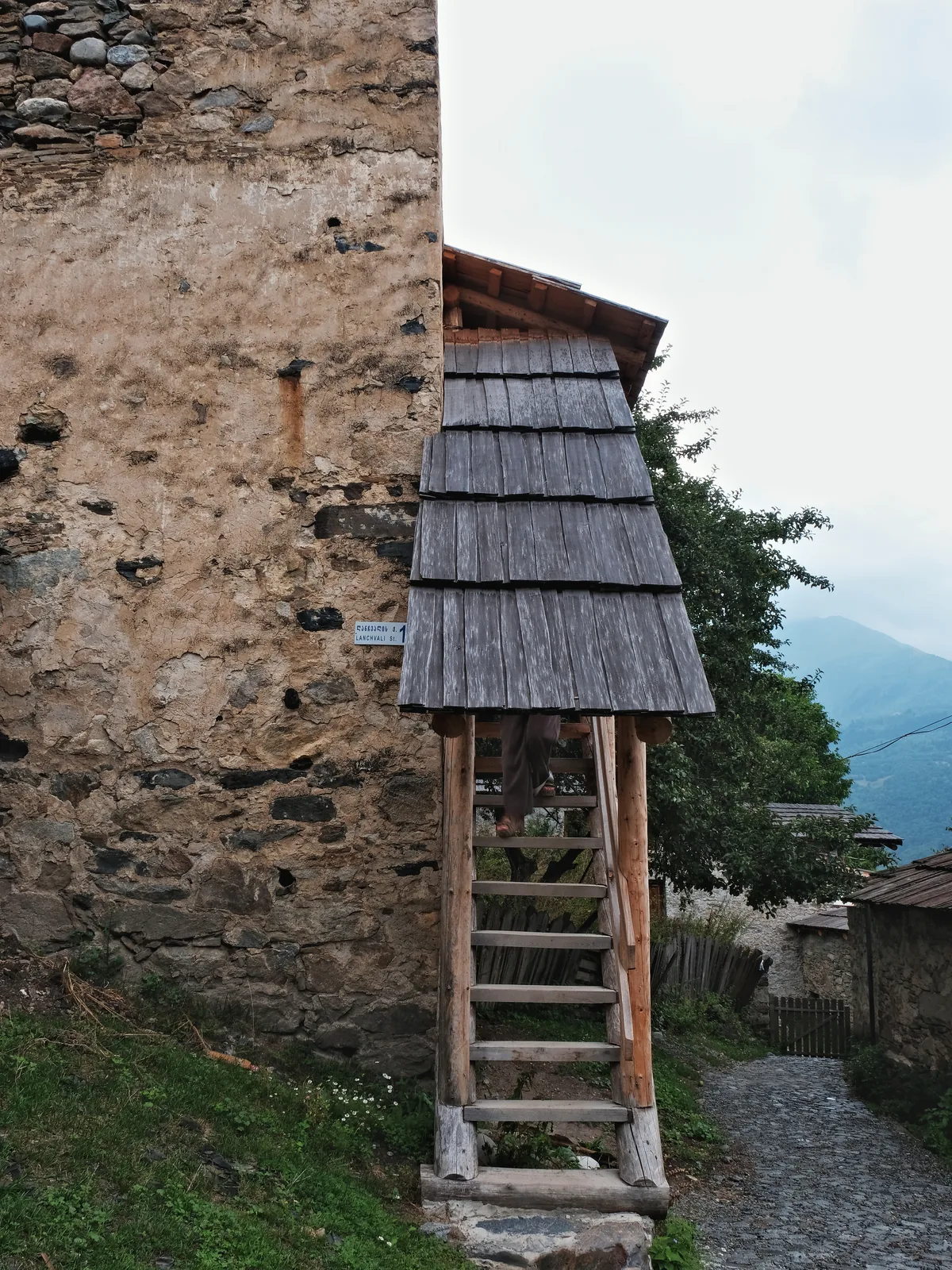
Floors are timber beams socketed into the masonry; the beam holes are clearly visible on any ruined tower. Movement between them was by removable ladder through a hatch — the whole defensive logic in one detail. An attacker who forces the ground-floor door still has to climb a ladder, one man at a time, through a hole in the ceiling, into a dark room held by people above him. Nobody does that twice.
The floors were used in a strict order:
- Ground floor. No windows, or a single slit. Cold storage: grain, cheese, cured meat, potatoes, seed.
- Middle floors. Living space during a siege, with narrow openings for light and for shooting.
- Upper floor. The fighting level, with arched embrasures on every face and, in many towers, machicolations — projecting stone brackets with gaps between them, so defenders could drop stones straight down onto anyone at the base.
- The cap. A low roof of overlapping slabs, steep enough to shed snow, heavy enough not to burn.
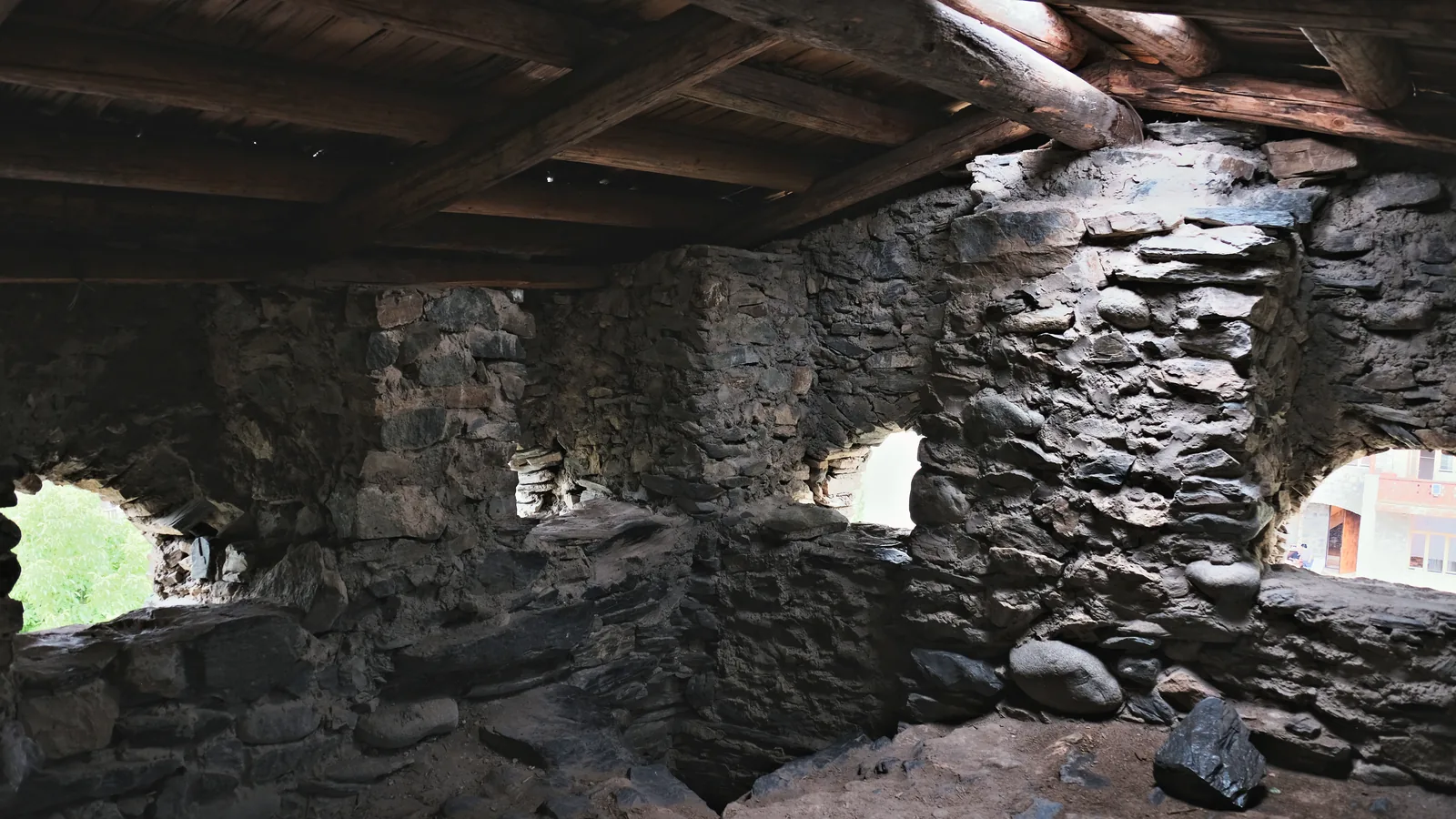
The machubi below is just as deliberate. One great room held the family and its animals through winter around a central open hearth, whose smoke blackened the roof timbers and, incidentally, preserved them. Dividing people from animals is a magnificent piece of carved joinery: a screen of oak or beech cut with rosettes, sun discs, spirals, stags and interlace, pierced so cattle could be fed from the far side. These partitions are among the finest woodwork in the Caucasus, and their motifs are older than Christianity in these mountains.
Against that partition stands the makhvshi — the carved high chair of the family head or community elder, and by extension the seat offered to an honoured guest. It is the most loaded object in a Svan house. Sitting in one uninvited is not a joke; being invited to is a serious compliment.
UNESCO, Free Svaneti and Chazhashi
Upper Svaneti was inscribed on the UNESCO World Heritage list in 1996 as an exceptionally well-preserved landscape of medieval mountain villages and tower houses. The core of the inscription is the Ushguli community at the head of the Enguri valley, and within it Chazhashi, protected as a museum village — the densest and least altered concentration of towers and machubi complexes in the region, with a ruined stronghold on the rock above.
The corridor running east from Mestia to Ushguli is what Svans call Free Svaneti: the communities never under princely rule. It is not an administrative unit, but it is the most useful mental map you can carry, because it tells you where to expect the tower-dense villages — and it is what most people are really after when they search for Upper Svaneti UNESCO.
Where to see Svan towers: a village-by-village guide
Not all tower villages are equal, and the most photographed is not the most rewarding. This is the order we use when we build a heritage itinerary.
Ushguli — Zhibiani, Chvibiani, Chazhashi, Murkmeli
Four villages at around 2,200 m at the foot of Shkhara, together one of the highest permanently inhabited places in Europe. Roughly two hundred people live here in about seventy families, and the community holds Svaneti's greatest surviving concentration of Ushguli towers — the tallest around twenty metres, the oldest with 9th-century fabric.
Walk it, do not drive it. From Zhibiani, where the Lamaria church stands on its knoll under the glacier, the road drops through Chvibiani, crosses to Chazhashi and its museum-village core, and ends at Murkmeli, the lowest and quietest, with an old stronghold in ruins on the slope above. Ninety minutes at walking pace, and the best ninety minutes of tower-looking in Georgia. Chazhashi rewards patience most: go into the lanes behind the main street, where towers stand two and three deep. Our Ushguli page covers logistics and road conditions.
Mestia and the Margiani house-museum
Mestia is where most visitors begin, and its towers are woven into a working modern town — instructive in itself, because it shows how these buildings survive when life goes on around them. The essential visit is the Margiani house-museum, a complete machubi-and-tower complex kept as it was: hearth, carved partition, byre, ladders, fighting floor. By family tradition the Margiani held eight towers here; four still stand, and together they are the clearest picture in Svaneti of one powerful clan's compound.
Pair it with the Mikheil Khergiani house museum and the regional Museum of History and Ethnography, whose icons, manuscripts and repoussé metalwork came out of the same villages as the towers. See our guide to Svaneti's museums for opening patterns, which shift with the season.
Lahiri — the cluster nobody photographs
If you want one village to yourself, this is it. Lahiri lies in the Mulakhi community, about five and a half kilometres from Chvabiani on the far bank of the Mulakhura, across a bridge. Its towers stand extremely close together on a very small footprint, and because reaching it is a half-day walk rather than a coach stop, you will probably have it alone. For understanding tower density as a defensive response rather than a view, Lahiri teaches more in an hour than Ushguli does in a day.
Adishi
At about 2,040 m, with a permanent population you can count on two hands, Adishi is the most atmospheric of the tower villages — partly because so much of it is ruined or half-inhabited, which exposes structure hidden elsewhere behind render and roofs. The 10th-century church of Jgrag, dedicated to St George and holding some of the most luminous frescoes in Svaneti, stands among the towers. Adishi sits on the classic Mestia–Ushguli trek; by road the last six kilometres need a proper 4×4.
Etseri and the Dadeshkeliani tower
West of Mestia, in former Princely Svaneti, Etseri is worth the detour for one building: the Dadeshkeliani tower, by local reckoning the tallest in Svaneti. We would not swear to that — nobody has surveyed every tower in the region — but it is unmistakably in the top rank, and it stands in exactly the context described above: a princely structure in a landscape with far fewer household towers around it. An excellent contrast day after Ushguli.
The tiny churches beside the towers
Svan churches are small. Not modest — genuinely small: many have a floor area of no more than about twenty square metres, with no room for a congregation inside. People step in to light a candle, leave an offering, touch an icon, and come out.
That one fact explains much of what you will witness. Because worship cannot happen indoors, everything that matters happens outside: the offering, the shared bread and cheese, the polyphonic singing, the circle dance, the toasts, the funeral rites. Svan religious life is conducted in the open air, in front of the church, among the towers. If timing allows, plan around a village festival — Lamproba, Kvirikoba, Lipanali — and you will see the towers doing what they always did: standing over a community at work.
What is happening to the towers now
Honesty matters more than nostalgia here. The towers are under pressure from three directions at once.
Abandonment. Many villages have lost most of their people to Tbilisi, Kutaisi and abroad. An unroofed tower fills with snow, freezes and loses a metre of wall in a decade. Plenty of the ruins you will photograph were intact within living memory.
Restoration. Some is excellent — heritage-funded, done with lime mortar and local stone. Some is not: cement pointing traps water in a wall built to breathe, and a cement-repaired tower can decay faster than an untouched one. Your guide can show you both in one village.
Tourism. More visitors means more money to keep roofs on, which is genuinely good. It also means guesthouse extensions, metal roofing, parking where hayfields were, and drones over people's houses at seven in the morning. We are part of that pressure and would rather manage it openly.
How to visit respectfully
- Towers and machubi complexes are almost all privately owned, and most adjoin a house someone lives in. Do not enter a yard, open a door or climb a ladder without being invited.
- Ask before photographing people, interiors or churchyards. A refusal is not hostility.
- Churches are active. Cover shoulders, take hats off, do not photograph during a rite, do not move offerings.
- Never sit in the makhvshi chair unless it is offered to you.
- Fly a drone only with clear permission, well away from services, funerals and livestock. In high season this is a real local grievance.
- If a family shows you their tower, accept the chacha, sit down and give them half an hour. That half hour will be the best part of your trip.
Photographing Svan towers
The towers are grey and the light does most of the work, so timing beats equipment. A few things we have learned running Films & Photography in these valleys:
Light. Flat midday sun is the worst condition there is: it kills the texture of the stonework and washes the mountains out. First light and the last hour transform Ushguli, where a low sun rakes across the wall faces and separates each tower from the one behind it. Overcast is no write-off — soft light suits carved interiors and the wet dark stone of a machubi.
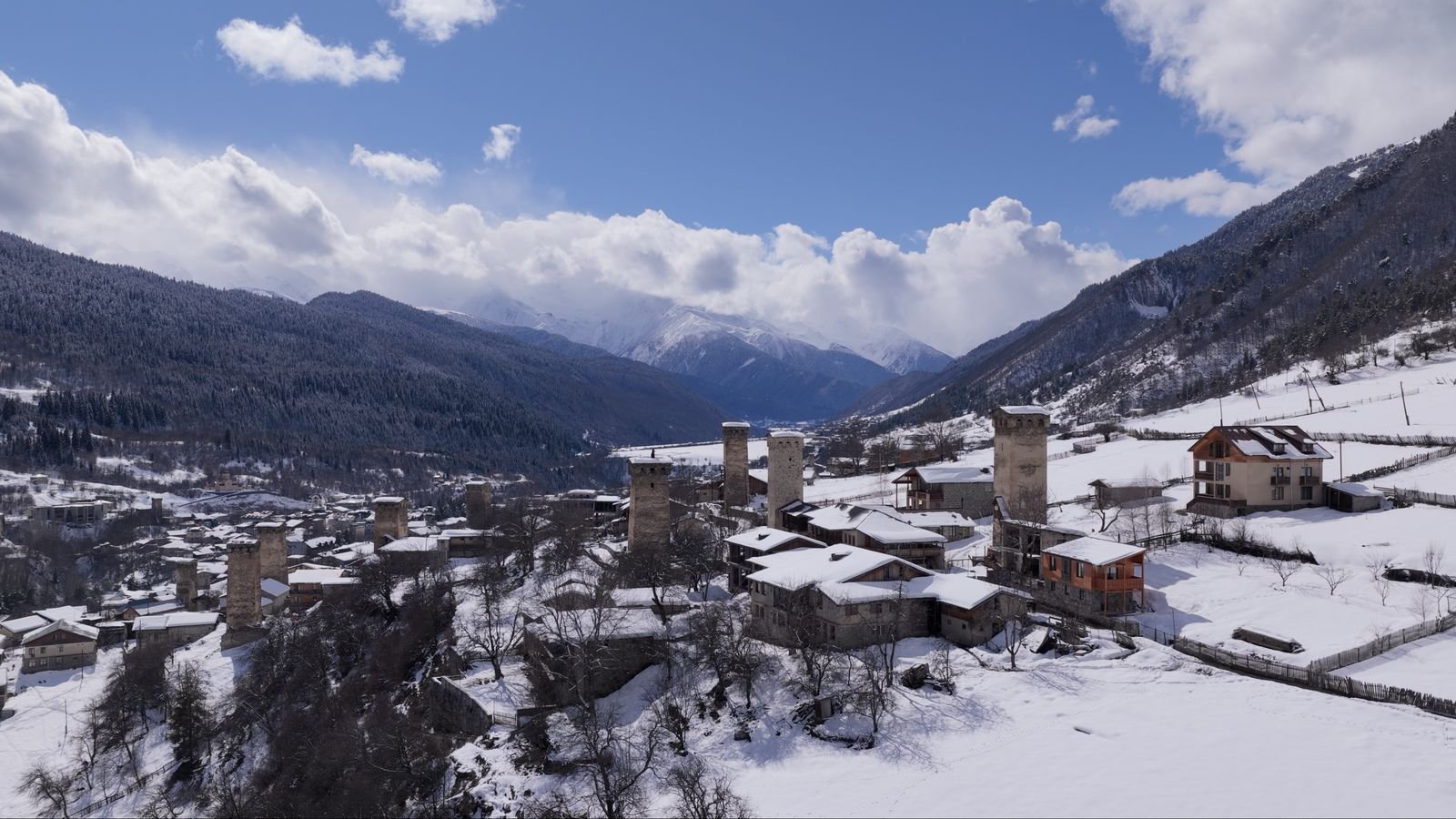
Seasons. Late September and October give gold hayfields, clear air and first snow on Shkhara: the strongest combination of the year. Deep winter is spectacular and difficult — towers against white are graphically superb, but the roads are the constraint. Late May and June bring green slopes and dramatic skies.
Composition. Resist shooting only the skyline. The best frames come from inside the village at eye level, using a lane, a hayrick or a doorway for scale. Keep people in shot where you have permission: a tower without a human being reads as a ruin, which is precisely what it is not.
How to visit the towers
Getting there. Mestia is the base for everything here, reachable by road from Zugdidi and Kutaisi or by small aircraft; see how to get to Mestia. From town, Ushguli is about two hours on the improved road, Mulakhi and Lahiri under half an hour, Etseri around an hour and a half.
On foot. The four-day Mestia to Ushguli trek is the finest way to see tower villages, because it delivers them in sequence and on foot, the way they were meant to be approached. Shorter day walks are in our hiking section.
With a guide. All of this can be done alone, and much of it will stay invisible if you do. Doors locked to visitors open for a Svan neighbour; the difference between a 10th-century wall and a 1970s repair is not obvious until someone points it out; the family stories attached to particular towers are written down nowhere. Our cultural tours are built around that access.
Season. Summer means every road open and every village reachable. Winter gives you the towers as they look in the imagination, plus short days and a real chance Ushguli is cut off for two of them. Both are worth doing; see when to visit Svaneti first.
See the towers with a Svan guide
The stone is the easy part — it stands there whether or not anyone explains it. What we add is the rest: whose tower that is, which wall is original and which was rebuilt, why that doorway faces the lane, which family ended a feud with which marriage, and where a door will be opened for you.
Have a look at our cultural tours — half-day walks in Mestia, full days in Ushguli and Chazhashi, multi-day heritage itineraries with supra dinners and village hosts — or simply get in touch and book, tell us how long you have, and we will build the route around it.
Where to see them
Related
Museums
Place guide
Cultural tours
Guided programme
Ushguli
Place guide
Mestia
Place guide
Supra evening
Guided programme
Plan this with us
Local Svan guides, based in Mestia all year round.
FAQ
Good to know
01How old are the Svan towers?+
Most were built between the 9th and 12th centuries. The oldest surviving fabric, in the Ushguli community, is 9th-century. Many towers were repaired or partly rebuilt later, so a single tower can contain a thousand years of work.
02Why were they built?+
Three reasons at once: raiding parties from over the passes, avalanche and rockfall, and — above all — the internal obligation of blood revenge, Litsvri. Because Free Svaneti had no lord and no court, every family needed its own defensible refuge, sometimes from its own neighbours.
03How many Svan towers are left?+
We do not quote a figure, and you should distrust anyone who states one with confidence: published totals differ enormously depending on whether ruins, stumps and rebuilt shafts are counted. The densest surviving groups are in Ushguli, Mestia, Mulakhi and Adishi.
04Can you go inside a Svan tower?+
Yes, in the right places. The Margiani house-museum in Mestia and the Ushguli Ethnographic Museum — set in a 13th-century machubi with its carved partition and makhvshi chair — are open to visitors. Most other towers are private homes, and access depends on knowing the family.
05Which village has the best towers?+
Ushguli for scale and for the UNESCO core, and within it Chazhashi for density and authenticity. Lahiri for a tight cluster with no crowds. Adishi for atmosphere and frescoes. Mestia for the best interior visit. One day: walk Ushguli end to end. Three days: add Lahiri and Adishi.
06Is Upper Svaneti really a UNESCO World Heritage site?+
Yes — inscribed in 1996 for its medieval villages and tower houses, with Ushguli and Chazhashi at the heart of the designation.
07What is a machubi?+
The traditional Svan dwelling: a single great stone hall where family and livestock wintered together around an open hearth, divided by a carved wooden partition, with storage and sleeping rooms above and a defensive tower attached. Machubi and tower are one household unit, not two buildings.
08Where does the Svan language come from?+
Svan is one of the four Kartvelian languages, related to Georgian, Megrelian and Laz, but it split off very early — which is why Georgian speakers cannot follow it. It has no traditional written form, is carried in speech and song, and UNESCO lists it as endangered. In the villages you will hear folk traditions tying the Svans to Mesopotamia or to ancient Greece. They are cherished locally and make wonderful listening, but they are not supported by linguistic evidence, and we tell them as stories rather than history.